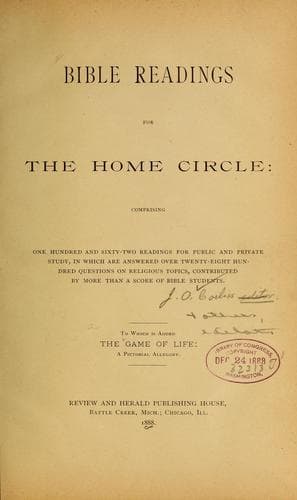
Bible -- Illustrations; Bible -- Indexes; Bible -- Study and teaching
Old Covenant New Covenant
Called the old covenant. Called the new covenant.
Called the first covenant. Called the second covenant.
A temporary compact. An everlasting covenant.
Dedicated with the blood of Ratified with the blood of
animals. Christ.
Was faulty. Is a better covenant.
Was established upon the Is established upon the
promises of the people. promises of God.
Had no mediator. Has a mediator.
Had no provision for the Provides for the forgiveness
forgiveness of sins. of sins.
Under this, the law was Under this, the law is written
written on tables of stone. in the heart.
Was of works. Is of grace.
Conditions: Obey and live; Conditions: Repent and be
disobey and die. forgiven; believe and be
saved.
_If._ If _ye_. If ye _will_. _I._ I _will_. I will _do_.
If ye will _do_.
If ye will do _all_. I will do _all_.
If ye will do all, _then_—ye I will do all, _and_—will be
shall be My people, _and_ I your God, _and_ ye shall be My
will be your God. people.
What Was Abolished By Christ
[Illustration.]
The Veil Rent In Twain. "Having abolished in His flesh ... the law ...
contained in ordinances." Eph. 2:15.
1. How did Christ’s death on the cross affect the whole sacrificial
system?
“After threescore and two weeks shall Messiah be cut off.... And He shall
confirm the covenant with many for one week: and _in the midst of the week
He shall cause the sacrifice and the oblation to cease_.” Dan. 9:26, 27.
2. What did Christ nail to His cross?
“Blotting out _the handwriting of ordinances_ that was against us, which
was contrary to us, and took it out of the way, _nailing it to His
cross_.” Col. 2:14.
3. What did He thus abolish?
“Having abolished in His flesh the enmity, even _the law of commandments
contained in ordinances_; for to make in Himself of twain one new man, so
making peace; and that He might reconcile both unto God in one body by the
cross, having slain the enmity thereby.” Eph. 2:15, 16.
4. To what did the ordinances pertain that were thus abolished?
“Let no man therefore judge you in _meat_, or in _drink_, or in respect of
an _holy day_, or of the _new moon_, or of the _sabbath days: which are a
shadow of things to come_; but the body is of Christ.” Col. 2:16, 17.
5. From what statement do we learn that these ordinances related to the
sacrificial system?
“For the law _having a shadow of good things to come_, and not the very
image of the things, can never with those sacrifices which they offered
year by year continually make the comers thereunto perfect.” Heb. 10:1.
6. What occurred at the time of the crucifixion which indicated that the
typical system had been taken away by Christ?
Public-domain text, read in full here on John Shaqi.
Reviews
Reviews
No reviews yet
Be the first to share your thoughts on this work.
Elsewhere in the archive
Join the Discussion
Join the discussion
Sign in to leave a comment or review.
Sign InorCreate an account