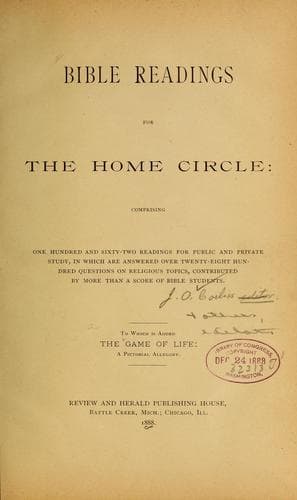
Bible -- Illustrations; Bible -- Indexes; Bible -- Study and teaching
“For it seemed good to the Holy Ghost, and to us, to lay upon you no
greater burden than these necessary things; _that ye abstain from meats
offered to idols, and from blood, and from things strangled, and from
fornication_: from which if ye keep yourselves, ye shall do well. Fare ye
well.” Verses 28, 29.
13. What charge was made against Stephen concerning his attitude toward
the ceremonial law?
“And set up false witnesses, which said, This man ceaseth not to speak
blasphemous words against _this holy place_, and _the law_: for we have
heard him say, that this Jesus of Nazareth shall destroy this place, and
shall _change the customs which Moses delivered us_.” Acts 6:13, 14.
14. What similar charge was brought against the apostle Paul?
“This fellow persuadeth men to worship God _contrary to the law_.” Acts
18:13.
15. What statement did Paul make concerning his faith and manner of
worship?
“But this I confess unto thee, that after the way which they call
_heresy_, so worship I the God of my fathers, _believing all things which
are written in the law and in the prophets_.” Acts 24:14.
NOTE.—The charge against Stephen and Paul was not based upon any
violation of the moral law, but upon their teaching concerning the
ceremonial law; and Paul’s admission that he was guilty of what
they called heresy meant simply that he differed from them as to
the obligation to observe any longer the precepts of the law which
was imposed upon them “until the time of reformation.” The simple
fact that such charges were preferred against these able exponents
and teachers of the gospel shows that in their view the ceremonial
law had been abolished by the death of Christ, and that, like the
giving of the moral law at Sinai it was designed to lead men to
Christ.
16. What is one of the offices of the moral law?
“Wherefore the law was _our schoolmaster to bring us unto Christ, that we
might be justified by faith_.” Gal. 3:24.
17. How is this same teaching expressed in another place?
“For _Christ is the end of the law for righteousness_ to every one that
believeth.” Rom. 10:4.
NOTE.—Murdock’s translation of the Syriac New Testament renders
this passage: “For Messiah is the _aim_ of the law, for
righteousness, unto every one that believeth in Him.”
18. In what statement is there a similar use of the word end?
“Receiving _the end of your faith_, even the salvation of your souls.” 1
Peter 1:9. See also 1 Tim. 1:5; James 5:11.
NOTE.—In the ceremonial law there was “a shadow of good things to
come,” a type of the mediatorial work of Christ, our great High
Priest. The moral law makes known sin, places the sinner under
condemnation, and forces him to Christ for pardon and cleansing.
The ceremonial law was abolished by the work of Christ, but the
moral law was established by both His life and death.
Public-domain text, read in full here on John Shaqi.
Reviews
Reviews
No reviews yet
Be the first to share your thoughts on this work.
Elsewhere in the archive
Join the Discussion
Join the discussion
Sign in to leave a comment or review.
Sign InorCreate an account