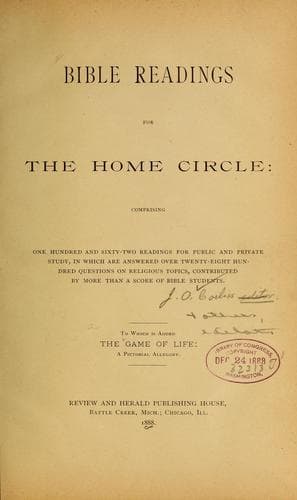
Bible -- Illustrations; Bible -- Indexes; Bible -- Study and teaching
6. How is the righteousness thus obtained described?
“And be found in Him, not having thine own righteousness, which is of the
law, but that which is through the faith of Christ, _the righteousness
which is of God by faith_.” Phil. 3:9.
7. Upon what basis is justification granted?
“And not as it was by one that sinned, so is the _gift_: for the judgment
was by one to condemnation, but _the free gift_ is of many offenses unto
justification.” Rom. 5:16.
8. Upon what basis does the reward come to one who works?
“Now to him that worketh is the reward not reckoned of grace, but of
_debt_.” Rom. 4:4.
9. Upon what condition is faith reckoned for righteousness?
“But to him that worketh not, but _believeth on Him that justifieth the
ungodly_, his faith is counted for righteousness.” Verse 5.
10. How does grace, as the ground of justification, exclude righteousness
by works?
“And _if by grace, then is it no more of works: otherwise grace is no more
grace_. But if it be of works, then is it no more grace: otherwise work is
no more work.” Rom. 11:6.
11. In what way are both Jews and Gentiles to be justified?
“Is He the God of the Jews only? is He not also of the Gentiles? Yes, of
the Gentiles also: seeing it is one God, which shall justify the
circumcision _by faith_, and uncircumcision _through faith_.” Rom. 3:29,
30.
12. What statement testifies to Abraham’s faith in God?
“He staggered not at the promise of God through unbelief; but was strong
in faith, giving glory to God; and _being fully persuaded that what He had
promised, He was able also to perform_.” Rom. 4:20, 21.
13. What did this bring to him?
“And therefore _it was imputed to him for righteousness_.” Verse 22.
14. How may we receive this same imputed righteousness?
“Now it was not written for his sake alone, that it was imputed to him;
but for us also, to whom it shall be imputed, _if we believe on Him that
raised up Jesus our Lord from the dead_.” Verses 23, 24.
15. Why must justifying faith lay hold upon both the death and the
resurrection of Christ?
“Who was _delivered for our offenses_, and _was raised again for our
justification_.” Verse 25. See 1 Cor. 15:17.
NOTE.—The resurrection of Christ, the promised Seed (Gal. 3:16),
was necessary in order to fulfil to Abraham the promise of an
innumerable seed; and therefore Abraham’s faith in the promise of
God, which included the resurrection, was reckoned to him for
righteousness. His faith laid hold upon that which made imputed
righteousness possible. See Heb. 11:17-19.
16. What is inseparable from the experience of justification by faith?
“Be it known unto you therefore, men and brethren, that through this man
is preached unto you _the forgiveness of sins_: and by Him all that
believe are _justified from all things_, from which ye could not be
justified by the law of Moses.” Acts 13:38, 39.
17. How has Christ made it possible for righteousness to be imputed to the
believer?
Public-domain text, read in full here on John Shaqi.
Reviews
Reviews
No reviews yet
Be the first to share your thoughts on this work.
Join the Discussion
Join the discussion
Sign in to leave a comment or review.
Sign InorCreate an account