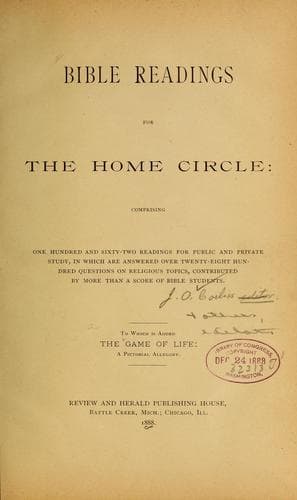
Bible -- Illustrations; Bible -- Indexes; Bible -- Study and teaching
As a guide, the Bible is without a rival. It gives a calm peace in
believing, and a firm hope of the future. It solves the great problem of
life and destiny, and inspires to a life of purity, patience, and
well-doing. It fills the heart with love for God and a desire to do good
to others, and thus prepares for usefulness here and for a home in heaven.
It teaches the value of the soul, by revealing the price that has been
paid to redeem it. It makes known the only antidote for sin, and presents
the only perfect code of morals ever given. It tells of the future and the
preparation necessary to meet it. It makes us bold for the right, and
sustains the soul in adversity and affliction. It lights up the dark
valley of death, and points to a life unending. It leads to God, and to
Christ, whom to know is life eternal. In short, it is the one book to live
by and die by.
As the king of Israel was instructed to write him a copy of the law, and
to read therein “all the days of his life,” that he might “fear the Lord,”
keep His word, and thus prolong his days and the days of his children
(Deut. 17:18-20), so ought men now to study the Bible, and from it learn
that fear which is the beginning of wisdom, and that knowledge which is
unto salvation. As an aid and incentive to this, “Bible Readings for the
Home Circle” has been prepared and published.
Bible Readings; Their Value and Use
Briefly stated, a Bible reading consists of questions asked concerning
some subject, and answers to them from the Bible. In other words, Bible
readings mean a topical study of the Bible by means of questions and
answers.
In either receiving or imparting knowledge, there is nothing like the
interrogation-point. Nothing so readily quickens thought or awakens
interest as a question. Children would learn little if they asked no
questions, and he would indeed be a poor teacher who asked and answered
none.
Knowing the value of this means of awakening thought, arousing interest,
and imparting information, God, in His wisdom, inspired those who wrote
the Bible to ask many questions, that He might set us to thinking and
studying about the great themes with which it deals. See Job 38:4, 7;
14:14; Ps. 8:4; Mal. 3:1, 2, 8; Ex. 32:26; 1 Chron. 29:5.
But God not only asks questions; He answers them. The following may be
cited as a few short Bible readings, taken, both questions and answers,
directly from the Bible itself:—
“What man is he that desireth life, and loveth many days, that he may see
good?
“Keep thy tongue from evil, and thy lips from speaking guile. Depart from
evil, and do good; seek peace, and pursue it.” Ps. 34:12-14.
“Who hath woe? who hath sorrow? who hath contentions? who hath babbling?
who hath wounds without cause? who hath redness of eyes?
“They that tarry long at the wine; they that go to seek mixed wine.” Prov.
23:29, 30.
“Who shall ascend into the hill of the Lord? or who shall stand in His
holy place?
Public-domain text, read in full here on John Shaqi.
Reviews
Reviews
No reviews yet
Be the first to share your thoughts on this work.
Join the Discussion
Join the discussion
Sign in to leave a comment or review.
Sign InorCreate an account