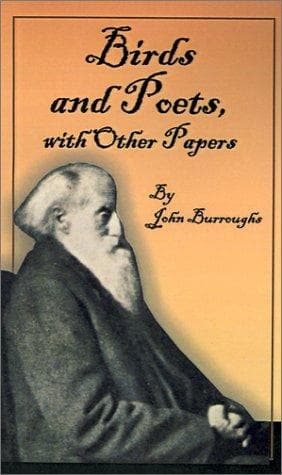
Birds and Poets : with Other PapersBurroughs, John
History
Birds and Poets : with Other Papers
Burroughs, John
American essays -- 19th century; Birds; Natural history -- Outdoor books; Nature
The influence of books and works of art upon an author may be seen in
all respectable writers. If knowledge alone made literature, or culture
genius, there would be no dearth of these things among the moderns. But
I feel bound to say that there is something higher and deeper than the
influence or perusal of any or all books, or all other productions of
genius,--a quality of information which the masters can never impart,
and which all the libraries do not hold. This is the absorption by an
author, previous to becoming so, of the spirit of nature, through
the visible objects of the universe, and his affiliation with them
subjectively and objectively. Not more surely is the blood quickened and
purified by contact with the unbreathed air than is the spirit of man
vitalized and made strong by intercourse with the real things of the
earth. The calm, all-permitting, wordless spirit of nature,--yet so
eloquent to him who hath ears to hear! The sunrise, the heaving sea,
the woods and mountains, the storm and the whistling winds, the gentle
summer day, the winter sights and sounds, the night and the high dome of
stars,--to have really perused these, especially from childhood onward,
till what there is in them, so impossible to define, finds its full mate
and echo in the mind,--this only is the lore which breathes the breath
of life into all the rest. Without it, literary productions may have the
superb beauty of statues, but with it only can they have the beauty of
life.
I was never troubled at all by what the critics called Whitman's want
of art, or his violation of art. I saw that he at once designedly swept
away all which the said critics have commonly meant by that term. The
dominant impression was of the living presence and voice. He would have
no curtains, he said, not the finest, between himself and his reader;
and in thus bringing me face to face with his subject I perceived he
not only did not escape conventional art, but I perceived an enlarged,
enfranchised art in this very abnegation of art. "When half-gods go,
whole gods arrive." It was obvious to me that the new style gained more
than it lost, and that in this fullest operatic launching forth of the
voice, though it sounded strange at first, and required the ear to get
used to it, there might be quite as much science, and a good deal more
power, than in the tuneful but constricted measures we were accustomed
to.
Public-domain text, read in full here on John Shaqi.
Reviews
Reviews
No reviews yet
Be the first to share your thoughts on this work.
Elsewhere in the archive
Join the Discussion
Join the discussion
Sign in to leave a comment or review.
Sign InorCreate an account