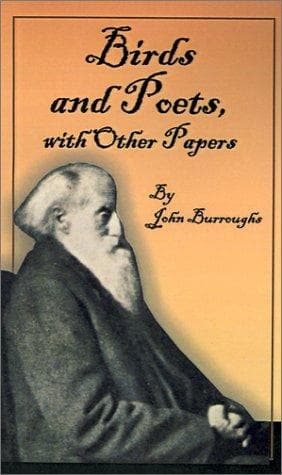
Birds and Poets : with Other PapersBurroughs, John
History
Birds and Poets : with Other Papers
Burroughs, John
American essays -- 19th century; Birds; Natural history -- Outdoor books; Nature
To the eye the page of the new poet presented about the same contrast
with the page of the popular poets that trees and the free, unbidden
growths of nature do with a carefully clipped hedge; and to the spirit
the contrast was about the same. The hedge is the more studiedly and
obviously beautiful, but, ah! there is a kind of beauty and satisfaction
in trees that one would not care to lose. There are symmetry and
proportion in the sonnet, but to me there is something I would not
exchange for them in the wild swing and balance of many free and
unrhymed passages in Shakespeare; like the one, for instance, in which
these lines occur:--
"To be imprisoned in the viewless winds,
And blown with restless violence round
About the pendent world."
Here is the spontaneous grace and symmetry of a forest tree, or a
soughing mass of foliage.
And this passage from my poet I do not think could be improved by the
verse-maker's art:--
"This day before dawn I ascended a hill and look'd at the crowded
heaven,
And I said to my Spirit, _When we become the enfolders of those orbs
and the pleasure and knowledge of everything in them, shall we be
fill'd and satisfied then?_
And my Spirit said, No, _we but level that lift, to pass and continue
beyond."_
Such breaking with the routine poetic, and with the grammar of verse,
was of course a dangerous experiment, and threw the composer absolutely
upon his intrinsic merits, upon his innately poetic and rhythmic
quality. He must stand or fall by these alone, since he discarded all
artificial, all adventitious helps. If interior, spontaneous rhythm
could not be relied on, and the natural music and flexibility of
language, then there was nothing to shield the ear from the pitiless
hail of words,--not one softly padded verse anywhere.
All poets, except those of the very first order, owe immensely to the
form, the art, the stereotyped metres, and stock figures they find ready
to hand. The form is suggestive,--it invites and aids expression, and
lends itself readily, like fashion, to conceal, or extenuate, or eke
out poverty of thought and feeling in the verse. The poet can "cut and
cover," as the farmer says, in a way the prose-writer never can, nor one
whose form is essentially prose, like Whitman's.
Public-domain text, read in full here on John Shaqi.
Reviews
Reviews
No reviews yet
Be the first to share your thoughts on this work.
Elsewhere in the archive
Join the Discussion
Join the discussion
Sign in to leave a comment or review.
Sign InorCreate an account