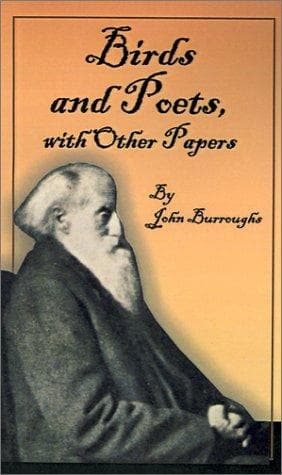
Birds and Poets : with Other PapersBurroughs, John
History
Birds and Poets : with Other Papers
Burroughs, John
American essays -- 19th century; Birds; Natural history -- Outdoor books; Nature
I, too, love to see the forms worthily used, as they always are by the
master; and I have no expectation that they are going out of fashion
right away. A great deal of poetry that serves, and helps sweeten one's
cup, would be impossible without them,--would be nothing when separated
from them. It is for the ear, and for the sense of tune and of carefully
carved and modeled forms, and is not meant to arouse the soul with the
taste of power, and to start off on journeys for itself. But the great
inspired utterances, like the Bible,--what would they gain by being cast
in the moulds of metrical verse? In all that concerns art, viewed from
any high standpoint,--proportion, continence, self-control, unfaltering
adherence to natural standards, subordination of parts, perfect
adjustment of the means to the end, obedience to inward law, no
trifling, no levity, no straining after effect, impartially attending to
the back and loins as well as to the head, and even holding toward his
subject an attitude of perfect acceptance and equality,--principles
of art to which alone the great spirits are amenable,--in all these
respects, I say, this poet is as true as an orb in astronomy.
To his literary expression pitched on scales of such unprecedented
breadth and loftiness, the contrast of his personal life comes in with a
foil of curious homeliness and simplicity. Perhaps never before has
the absolute and average _commonness of humanity_ been so steadily and
unaffectedly adhered to. I give here a glimpse of him in Washington on
a Navy Yard horse-car, toward the close of the war, one summer day at
sundown. The car is crowded and suffocatingly hot, with many passengers
on the rear platform, and among them a bearded, florid-faced man,
elderly but agile, resting against the dash, by the side of the young
conductor, and evidently his intimate friend. The man wears a broad-brim
white hat. Among the jam inside, near the door, a young Englishwoman, of
the working class, with two children, has had trouble all the way with
the youngest, a strong, fat, fretful, bright babe of fourteen or fifteen
months, who bids fair to worry the mother completely out, besides
becoming a howling nuisance to everybody. As the car tugs around Capitol
Hill the young one is more demoniac than ever, and the flushed and
perspiring mother is just ready to burst into tears with weariness and
vexation. The car stops at the top of the hill to let off most of the
rear platform passengers, and the white-hatted man reaches inside, and,
gently but firmly disengaging the babe from its stifling place in the
mother's arms, takes it in his own, and out in the air. The astonished
and excited child, partly in fear, partly in satisfaction at the change,
stops its screaming, and, as the man adjusts it more securely to his
breast, plants its chubby hands against him, and, pushing off as far
as it can, gives a good long look squarely in his face,--then, as if
Public-domain text, read in full here on John Shaqi.
Reviews
Reviews
No reviews yet
Be the first to share your thoughts on this work.
Elsewhere in the archive
Join the Discussion
Join the discussion
Sign in to leave a comment or review.
Sign InorCreate an account