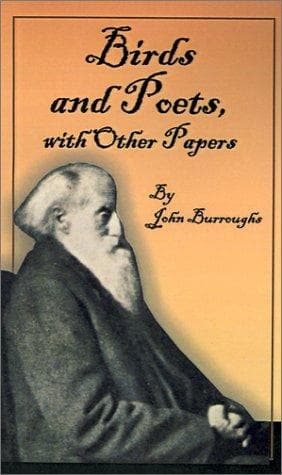
Birds and Poets : with Other PapersBurroughs, John
History
Birds and Poets : with Other Papers
Burroughs, John
American essays -- 19th century; Birds; Natural history -- Outdoor books; Nature
It is for these and kindred reasons that Walt Whitman is more read
abroad than in his own country. It is on the rank, human, and
emotional side--sex, magnetism, health, physique,--that he is so
full. Then his receptivity and assimilative powers are enormous, and
he demands these in his reader. In fact, his poems are physiological as
much as they are intellectual. They radiate from his entire being,
and are charged to repletion with that blended quality of mind and
body--psychic and physiologic--which the living form and presence send
forth. Never before in poetry has the body received such ennoblement.
The great theme is IDENTITY, and identity comes through the body; and
all that pertains to the body, the poet teaches, is entailed upon
the spirit. In his rapt gaze, the body and the soul are one, and what
debases the one debases the other. Hence he glorifies the body. Not more
ardently and purely did the great sculptors of antiquity carve it in the
enduring marble than this poet has celebrated it in his masculine and
flowing lines. The bearing of his work in this direction is invaluable.
Well has it been said that the man or the woman who has "Leaves of
Grass" for a daily companion will be under the constant, invisible
influence of sanity, cleanliness, strength, and a gradual severance from
all that corrupts and makes morbid and mean.
In regard to the unity and construction of the poems, the reader
sooner or later discovers the true solution to be, that the dependence,
cohesion, and final reconciliation of the whole are in the Personality
of the poet himself. As in Shakespeare everything is strung upon the
plot, the play, and loses when separated from it, so in this poet every
line and sentence refers to and necessitates the Personality behind it,
and derives its chief significance therefrom. In other words, "Leaves of
Grass" is essentially a dramatic poem, a free representation of man in
his relation to the outward world,--the play, the interchanges between
him and it, apart from social and artificial considerations,--in which
we discern the central purpose or thought to be for every man and woman
his or her Individuality, and around that, Nationality. To show rather
than to tell,--to body forth as in a play how these arise and blend; how
the man is developed and recruited, his spirit's descent; how he walks
through materials absorbing and conquering them; how he confronts the
immensities of time and space; where are the true sources of his power,
the soul's real riches,--that which "adheres and goes forward and is not
dropped by death;" how he is all defined and published and made certain
through his body; the value of health and physique; the great solvent,
Sympathy,--to show the need of larger and fresher types in art and in
life, and then how the state is compacted, and how the democratic idea
is ample and composite, and cannot fail us,--to show all this, I
say, not as in a lecture or a critique, but suggestively and
Public-domain text, read in full here on John Shaqi.
Reviews
Reviews
No reviews yet
Be the first to share your thoughts on this work.
Elsewhere in the archive
Join the Discussion
Join the discussion
Sign in to leave a comment or review.
Sign InorCreate an account