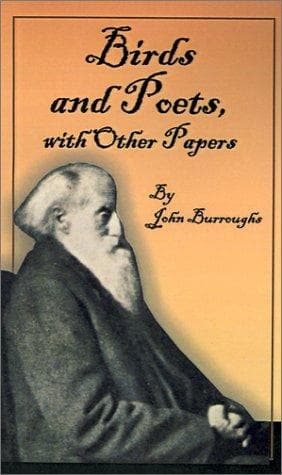
Birds and Poets : with Other PapersBurroughs, John
History
Birds and Poets : with Other Papers
Burroughs, John
American essays -- 19th century; Birds; Natural history -- Outdoor books; Nature
inferentially,--to work it out freely and picturesquely, with endless
variations, with person and picture and parable and adventure, is the
lesson and object of "Leaves of Grass." From the first line, where the
poet says,
"I loafe and invite my Soul,"
to the last, all is movement and fusion,--all is clothed in flesh and
blood. The scene changes, the curtain rises and falls, but the theme is
still Man,--his opportunities, his relations, his past, his future, his
sex, his pride in himself, his omnivorousness, his "great hands," his
yearning heart, his seething brain, the abysmal depths that underlie him
and open from him, all illustrated in the poet's own character,--he the
chief actor always. His personality directly facing you, and with its
eye steadily upon you, runs through every page, spans all the details,
and rounds and completes them, and compactly holds them. This gives the
form and the art conception, and gives homogeneousness.
When Tennyson sends out a poem, it is perfect, like an apple or a peach;
slowly wrought out and dismissed, it drops from his boughs holding
a conception or an idea that spheres it and makes it whole. It is
completed, distinct, and separate,--might be his, or might be any man's.
It carries his quality, but it is a thing of itself, and centres and
depends upon itself. Whether or not the world will hereafter consent,
as in the past, to call only beautiful creations of this sort _poems,_
remains to be seen. But this is certainly not what Walt Whitman does,
or aims to do, except in a few cases. He completes no poems apart and
separate from himself, and his pages abound in hints to that effect:--
"Let others finish specimens--I never finish specimens;
I shower them by exhaustless laws, as Nature does, fresh
and modern continually."
His lines are pulsations, thrills, waves of force, indefinite dynamics,
formless, constantly emanating from the living centre, and they carry
the quality of the author's personal presence with them in a way that is
unprecedented in literature.
Occasionally there is a poem or a short piece that detaches itself,
and assumes something like ejaculatory and statuesque proportion, as
"O Captain, my Captain," "Pioneers," "Beat, Beat, Drums," and others in
"Drum-Taps;" but all the great poems, like "Walt Whitman," "Song of
the Open Road," "Crossing Brooklyn Ferry," "To Working Men,"
"Sleep-Chasings," etc., are out-flamings, out-rushings, of the pent
fires of the poet's soul. The first-named poem, which is the seething,
dazzling sun of his subsequent poetic system, shoots in rapid succession
waves of almost consuming energy. It is indeed a central orb of fiercest
light and heat, swept by wild storms of emotion, but at the same time
of sane and beneficent potentiality. Neither in it nor in either of
the others is there the building-up of a fair verbal structure,
a symmetrical piece of mechanism, whose last stone is implied and
necessitated in the first.
Public-domain text, read in full here on John Shaqi.
Reviews
Reviews
No reviews yet
Be the first to share your thoughts on this work.
Elsewhere in the archive
Join the Discussion
Join the discussion
Sign in to leave a comment or review.
Sign InorCreate an account