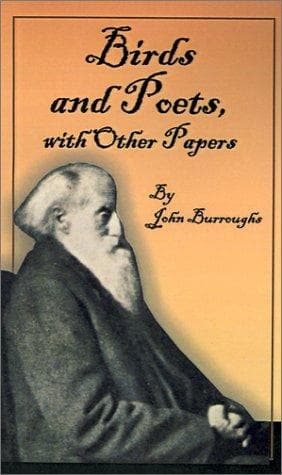
Birds and Poets : with Other PapersBurroughs, John
History
Birds and Poets : with Other Papers
Burroughs, John
American essays -- 19th century; Birds; Natural history -- Outdoor books; Nature
"The critic's great error," says Heine, "lies in asking, 'What ought
the artist to do?' It would be far more correct to ask, 'What does the
artist intend?'"
It is probably partly because his field is so large, his demands
so exacting, his method so new (necessarily so), and from the whole
standard of the poems being what I may call an astronomical one, that
the critics complain so generally of want of form in him. And the
critics are right enough, as far as their objection goes. There is no
deliberate form here, any more than there is in the forces of nature.
Shall we say, then, that nothing but the void exists? The void is filled
by a Presence. There is a controlling, directing, overarching will
in every page, every verse, that there is no escape from. Design and
purpose, natural selection, growth, culmination, are just as pronounced
as in any poet.
There is a want of form in the unfinished statue, because it is
struggling into form; it is nothing without form; but there is no want
of form in the elemental laws and effusions,--in fire, or water, or
rain, or dew, or the smell of the shore or the plunging waves. And may
there not be the analogue of this in literature,--a potent, quickening,
exhilarating quality in words, apart from and without any consideration
of constructive form? Under the influence of the expansive, creative
force that plays upon me from these pages, like sunlight or gravitation,
the question of form never comes up, because I do not for one moment
escape the eye, the source from which the power and action emanate.
I know that Walt Whitman has written many passages with reference far
more to their position, interpretation, and scanning ages hence, than
for current reading. Much of his material is too near us; it needs time.
Seen through the vista of long years, perhaps centuries, it will assume
quite different hues. Perhaps those long lists of trades, tools, and
occupations would not be so repellent if we could read them, as we read
Homer's catalogue of the ships, through the retrospect of ages. They are
justified in the poem aside from their historic value, because they
are alive and full of action,--panoramas of the whole mechanical and
industrial life of America, north, east, south, west,--bits of scenery,
bird's-eye views, glimpses of moving figures, caught as by a flash,
characteristic touches indoors and out, all passing in quick succession
before you. They have in the fullest measure what Lessing demands in
poetry,--the quality of ebbing and flowing action, as distinct from the
dead water of description; they are thoroughly dramatic, fused, pliant,
and obedient to the poet's will. No glamour is thrown over them, no wash
of sentiment; and if they have not the charm of novelty and distance,
why, that is an accident that bars them in a measure to us, but not to
the future. Very frequently in these lists or enumerations of objects,
actions, shows, there are sure to occur lines of perfect description:--
Public-domain text, read in full here on John Shaqi.
Reviews
Reviews
No reviews yet
Be the first to share your thoughts on this work.
Elsewhere in the archive
Join the Discussion
Join the discussion
Sign in to leave a comment or review.
Sign InorCreate an account