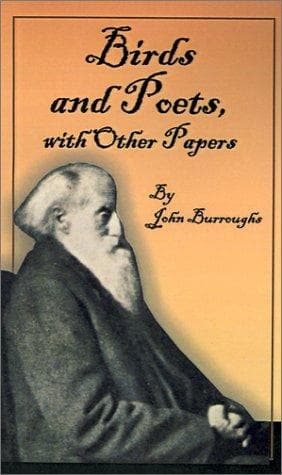
Birds and Poets : with Other PapersBurroughs, John
History
Birds and Poets : with Other Papers
Burroughs, John
American essays -- 19th century; Birds; Natural history -- Outdoor books; Nature
It needs but a little pondering to see that the great poet of the future
will not be afraid of science, but will rather seek to plant his feet
upon it as upon a rock. He knows that, from an enlarged point of view,
there is no feud between Science and Poesy, any more than there is
between Science and Religion, or between Science and Life. He sees that
the poet and the scientist do not travel opposite but parallel roads,
that often approach each other very closely, if they do not at times
actually join. The poet will always pause when he finds himself in
opposition to science; and the scientist is never more worthy the name
than when he escapes from analysis into synthesis, and gives us living
wholes. And science, in its present bold and receptive mood, may be said
to be eminently creative, and to have made every first-class thinker and
every large worker in any aesthetic or spiritual field immeasurably
its debtor. It has dispelled many illusions, but it has more than
compensated the imagination by the unbounded vistas it has opened up
on every hand. It has added to our knowledge, but it has added to our
ignorance in the same measure: the large circle of light only reveals
the larger circle of darkness that encompasses it, and life and being
and the orbs are enveloped in a greater mystery to the poet to-day than
they were in the times of Homer or Isaiah. Science, therefore, does not
restrict the imagination, but often compels it to longer flights.
The conception of the earth as an orb shooting like a midnight meteor
through space, a brand cast by the burning sun with the fire at its
heart still unquenched, the sun itself shooting and carrying the whole
train of worlds with it, no one knows whither,--what a lift has science
given the imagination in this field! Or the tremendous discovery of the
correlation and conservation of forces, the identity and convertibility
of heat and force and motion, and that no ounce of power is lost,
but forever passed along, changing form but not essence, is a poetic
discovery no less than a scientific one. The poets have always felt
that it must be so, and, when the fact was authoritatively announced by
science, every profound poetic mind must have felt a thrill of pleasure.
Or the nebular hypothesis of the solar system,--it seems the conception
of some inspired madman, like William Blake, rather than the cool
conclusion of reason, and to carry its own justification, as great
power always does. Indeed, our interest in astronomy and geology is
essentially a poetic one,--the love of the marvelous, of the sublime,
and of grand harmonies. The scientific conception of the sun is
strikingly Dantesque, and appalls the imagination. Or the hell of fire
through which the earth has passed, and the aeons of monsters from which
its fair forms have emerged,--from which of the seven circles of the
Inferno did the scientist get his hint? Indeed, science everywhere
Public-domain text, read in full here on John Shaqi.
Reviews
Reviews
No reviews yet
Be the first to share your thoughts on this work.
Elsewhere in the archive
Join the Discussion
Join the discussion
Sign in to leave a comment or review.
Sign InorCreate an account