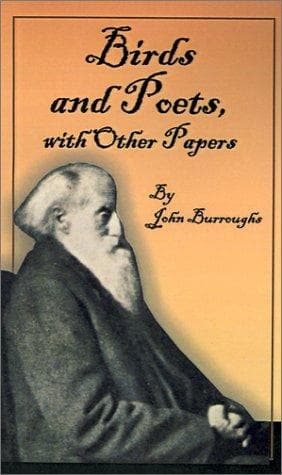
Birds and Poets : with Other PapersBurroughs, John
History
Birds and Poets : with Other Papers
Burroughs, John
American essays -- 19th century; Birds; Natural history -- Outdoor books; Nature
reveals a carnival of mightier gods than those that cut such fantastic
tricks in the ancient world. Listen to Tyndall on light, or to Youmans
on the chemistry of a sunbeam, and see how fable pales its ineffectual
fires, and the boldest dreams of the poets are eclipsed.
The vibratory theory of light and its identity with the laws of sound,
the laws of the tides and the seasons, the wonders of the spectroscope,
the theory of gravitation, of electricity, of chemical affinity, the
deep beneath deep of the telescope, the world within world of the
microscope,--in these and many other fields it is hard to tell whether
it is the scientist or the poet we are listening to. What greater magic
than that you can take a colorless ray of light, break it across a
prism, and catch upon a screen all the divine hues of the rainbow?
In some respects science has but followed out and confirmed the dim
foreshadowings of the human breast. Man in his simplicity has called the
sun father and the earth mother. Science shows this to be no fiction,
but a reality; that we are really children of the sun, and that every
heart-beat, every pound of force we exert, is a solar emanation. The
power with which you now move and breathe came from the sun just as
literally as the bank-notes in your pocket came from the bank.
The ancients fabled the earth as resting upon the shoulders of Atlas,
and Atlas as standing upon a turtle; but what the turtle stood upon was
a puzzle. An acute person says that science has but changed the terms
of the equation, but that the unknown quantity is the same as ever. The
earth now rests upon the sun,--in his outstretched palm; the sun rests
upon some other sun, and that upon some other; but what they all finally
rest upon, who can tell? Well may Tennyson speak of the "fairy tales of
science," and well may Walt Whitman say:--
"I lie abstracted, and hear beautiful tales of things, and the
reasons of things;
They are so beautiful, I nudge myself to listen."
Public-domain text, read in full here on John Shaqi.
Reviews
Reviews
No reviews yet
Be the first to share your thoughts on this work.
Elsewhere in the archive
Join the Discussion
Join the discussion
Sign in to leave a comment or review.
Sign InorCreate an account