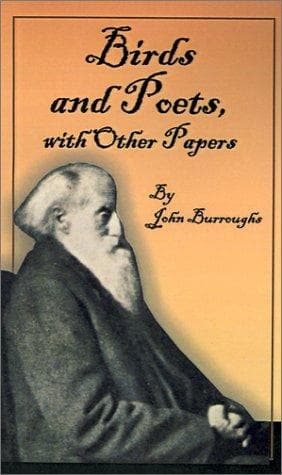
Birds and Poets : with Other PapersBurroughs, John
History
Birds and Poets : with Other Papers
Burroughs, John
American essays -- 19th century; Birds; Natural history -- Outdoor books; Nature
One of the marks of the great humorist, like Cervantes, or Sterne, or
Scott, is that he approaches his subject, not through his head merely,
but through his heart, his love, his humanity. His humor is full of
compassion, full of the milk of human kindness, and does not separate
him from his subject, but unites him to it by vital ties. How Sterne
loved Uncle Toby and sympathized with him, and Cervantes his luckless
knight! I fear our humorists would have made fun of them, would have
shown them up and stood aloof superior, and "laughed a laugh of merry
scorn." Whatever else the great humorist or poet, or any artist, may be
or do, there is no contempt in his laughter. And this point cannot
be too strongly insisted on in view of the fact that nearly all our
humorous writers seem impressed with the conviction that their own
dignity and self-respect require them to _look down_ upon what they
portray. But it is only little men who look down upon anything or speak
down to anybody. One sees every day how clear it is that specially fine,
delicate, intellectual persons cannot portray satisfactorily coarse,
common, uncultured characters. Their attitude is at once scornful and
supercilious. The great man, like Socrates, or Dr. Johnson, or Abraham
Lincoln, is just as surely coarse as he is fine, but the complaint I
make with our humorists is that they are fine and not coarse in any
healthful and manly sense. A great part of the best literature and the
best art is of the vital fluids, the bowels, the chest, the appetites,
and is to be read and judged only through love and compassion. Let us
pray for unction, which is the marrowfat of humor, and for humility,
which is the badge of manhood.
As the voice of the American has retreated from his chest to his
throat and nasal passages, so there is danger that his contribution to
literature will soon cease to imply any blood or viscera, or healthful
carnality, or depth of human and manly affection, and will be the fruit
entirely of our toploftical brilliancy and cleverness.
What I complain of is just as true of the essayists and the critics as
of the novelists. The prevailing tone here also is born of a feeling of
immense superiority. How our lofty young men, for instance, look down
upon Carlyle, and administer their masterly rebukes to him! But see how
Carlyle treats Burns, or Scott, or Johnson, or Novalis, or any of his
heroes. Ay, there's the rub; he makes heroes of them, which is not a
trick of small natures. He can say of Johnson that he was "moonstruck,"
but it is from no lofty height of fancied superiority, but he uses the
word as a naturalist uses a term to describe an object he loves.
What we want, and perhaps have got more of than I am ready to admit, is
a race of writers who affiliate with their subjects, and enter into them
through their blood, their sexuality and manliness, instead of
standing apart and criticising them and writing about them through mere
intellectual cleverness and "smartness."
Public-domain text, read in full here on John Shaqi.
Reviews
Reviews
No reviews yet
Be the first to share your thoughts on this work.
Join the Discussion
Join the discussion
Sign in to leave a comment or review.
Sign InorCreate an account