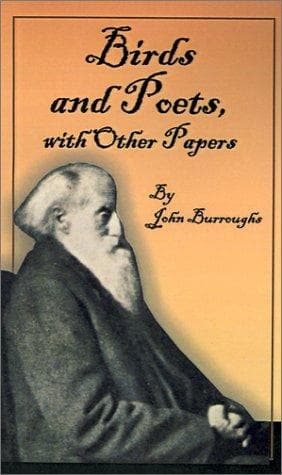
Birds and Poets : with Other PapersBurroughs, John
History
Birds and Poets : with Other Papers
Burroughs, John
American essays -- 19th century; Birds; Natural history -- Outdoor books; Nature
The cow figures in Grecian mythology, and in the Oriental literature is
treated as a sacred animal. "The clouds are cows and the rain milk." I
remember what Herodotus says of the Egyptians' worship of heifers and
steers; and in the traditions of the Celtic nations the cow is regarded
as a divinity. In Norse mythology the milk of the cow Andhumbla afforded
nourishment to the Frost giants, and it was she that licked into being
and into shape a god, the father of Odin. If anything could lick a god
into shape, certainly the cow could do it. You may see her perform this
office for young Taurus any spring. She licks him out of the fogs and
bewilderments and uncertainties in which he finds himself on first
landing upon these shores, and up onto his feet in an incredibly short
time. Indeed, that potent tongue of hers can almost make the dead alive
any day, and the creative lick of the old Scandinavian mother cow is
only a large-lettered rendering of the commonest facts.
The horse belongs to the fiery god Mars. He favors war, and is one of
its oldest, most available, and most formidable engines. The steed is
clothed with thunder, and smells the battle from afar; but the cattle
upon a thousand hills denote that peace and plenty bear sway in the
land. The neighing of the horse is a call to battle; but the lowing of
old Brockleface in the valley brings the golden age again. The savage
tribes are never without the horse; the Scythians are all mounted; but
the cow would tame and humanize them. When the Indians will cultivate
the cow, I shall think their civilization fairly begun. Recently, when
the horses were sick with the epizooetic, and the oxen came to the city
and helped to do their work, what an Arcadian air again filled the
streets! But the dear old oxen,--how awkward and distressed they looked!
Juno wept in the face of every one of them. The horse is a true citizen,
and is entirely at home in the paved streets; but the ox,--what a
complete embodiment of all rustic and rural things! Slow, deliberate,
thick-skinned, powerful, hulky, ruminating, fragrant-breathed, when he
came to town the spirit and suggestion of all Georgics and Bucolics came
with him. O citizen, was it only a plodding, unsightly brute that went
by? Was there no chord in your bosom, long silent, that sweetly vibrated
at the sight of that patient, Herculean couple? Did you smell no hay or
cropped herbage, see no summer pastures with circles of cool shade, hear
no voice of herds among the hills? They were very likely the only horses
your grandfather ever had. Not much trouble to harness and unharness
them. Not much vanity on the road in those days. They did all the work
on the early pioneer farm. They were the gods whose rude strength first
broke the soil. They could live where the moose and the deer could. If
there was no clover or timothy to be had, then the twigs of the basswood
and birch would do. Before there were yet fields given up to grass, they
Public-domain text, read in full here on John Shaqi.
Reviews
Reviews
No reviews yet
Be the first to share your thoughts on this work.
Elsewhere in the archive
Join the Discussion
Join the discussion
Sign in to leave a comment or review.
Sign InorCreate an account