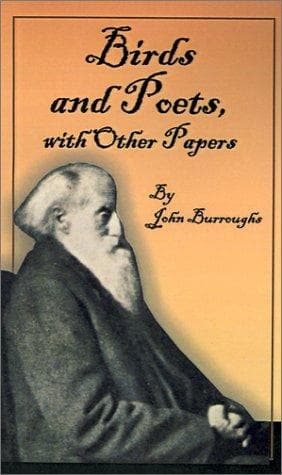
Birds and Poets : with Other PapersBurroughs, John
History
Birds and Poets : with Other Papers
Burroughs, John
American essays -- 19th century; Birds; Natural history -- Outdoor books; Nature
found ample pasturage in the woods. Their wide-spreading horns gleamed
in the duskiness, and their paths and the paths of the cows became the
future roads and highways, or even the streets of great cities.
All the descendants of Odin show a bovine trace, and cherish and
cultivate the cow. In Norway she is a great feature. Professor Boyesen
describes what he calls the _saeter_, the spring migration of the dairy
and dairymaids, with all the appurtenances of butter and cheese making,
from the valleys to the distant plains upon the mountains, where the
grass keeps fresh and tender till fall. It is the great event of the
year in all the rural districts. Nearly the whole family go with the
cattle and remain with them. At evening the cows are summoned home with
a long horn, called the _loor,_ in the hands of the milkmaid. The
whole herd comes winding down the mountain-side toward the _saeter_ in
obedience to the mellow blast.
What were those old Vikings but thick-hided bulls that delighted
in nothing so much as goring each other? And has not the charge of
beefiness been brought much nearer home to us than that? But about all
the northern races there is something that is kindred to cattle in the
best sense,--something in their art and literature that is essentially
pastoral, sweet-breathed, continent, dispassionate, ruminating,
wide-eyed, soft-voiced,--a charm of kine, the virtue of brutes.
The cow belongs more especially to the northern peoples, to the region
of the good, green grass. She is the true _grazing_ animal. That broad,
smooth, always dewy nose of hers is just the suggestion of greensward.
She caresses the grass; she sweeps off the ends of the leaves; she reaps
it with the soft sickle of her tongue. She crops close, but she does
not bruise or devour the turf like the horse. She is the sward's best
friend, and will make it thick and smooth as a carpet.
"The turfy mountains where live the nibbling sheep"
are not for her. Her muzzle is too blunt; then she does not _bite_ as do
the sheep; she has no upper teeth; she _crops._ But on the lower slopes,
and margins, and rich bottoms, she is at home. Where the daisy and the
buttercup and clover bloom, and where corn will grow, is her proper
domain. The agriculture of no country can long thrive without her. Not
only a large part of the real, but much of the potential, wealth of the
land is wrapped up in her.
Then the cow has given us some good words and hints. How could we get
along without the parable of the cow that gave a good pail of milk and
then kicked it over? One could hardly keep house without it. Or the
parable of the cream and the skimmed milk, or of the buttered bread? We
know, too, through her aid, what the horns of the dilemma mean, and what
comfort there is in the juicy cud of reverie.
Public-domain text, read in full here on John Shaqi.
Reviews
Reviews
No reviews yet
Be the first to share your thoughts on this work.
Elsewhere in the archive
Join the Discussion
Join the discussion
Sign in to leave a comment or review.
Sign InorCreate an account