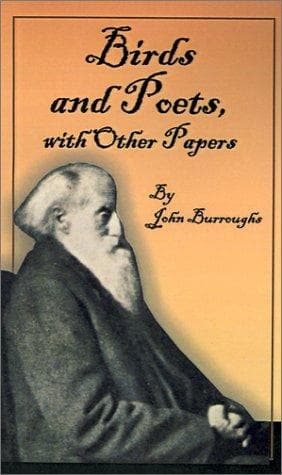
Birds and Poets : with Other PapersBurroughs, John
History
Birds and Poets : with Other Papers
Burroughs, John
American essays -- 19th century; Birds; Natural history -- Outdoor books; Nature
It is ever present to the true artist, in his attempt to report nature,
that every object as it stands in the circuit of cause and effect has
a history which involves its surroundings, and that the depth of the
interest which it awakens in us is in proportion as its integrity in
this respect is preserved. In nature we are prepared for any opulence
of color or of vegetation, or freak of form, or display of any kind,
because of the preponderance of the common, ever-present feature of the
earth. The foil is always at hand. In like manner in the master poems we
are never surfeited with mere beauty.
Woe to any artist who disengages Beauty from the wide background of
rudeness, darkness, and strength,--and disengages her from absolute
nature! The mild and beneficent aspects of nature,--what gulfs and
abysses of power underlie them! The great shaggy, barbaric earth,--yet
the summing-up, the plenum, of all we know or can know of beauty! So the
orbic poems of the world have a foundation as of the earth itself, and
are beautiful because they are something else first. Homer chose for his
groundwork War, clinching, tearing, tugging war; in Dante, it is Hell;
in Milton, Satan and the Fall; in Shakespeare, it is the fierce Feudal
world, with its towering and kingly personalities; in Byron, it is
Revolt and diabolic passion. When we get to Tennyson, the lion is a good
deal tamed, but he is still there in the shape of the proud, haughty,
and manly Norman, and in many forms yet stimulates the mind.
The perception of cosmical beauty comes by a vital original process.
It is in some measure a creative act, and those works that rest upon
it make demands--perhaps extraordinary ones--upon the reader or the
beholder. We regard mere surface glitter, or mere verbal sweetness, in
a mood entirely passive, and with a pleasure entirely profitless. The
beauty of excellent stage scenery seems much more obvious and easy of
apprehension than the beauty of trees and hills themselves, inasmuch as
the act of association in the mind is much easier and cheaper than the
act of original perception.
Only the greatest works in any department afford any explanation of this
wonder we call nature, or aid the mind in arriving at correct
notions concerning it. To copy here and there a line or a trait is no
explanation; but to translate nature into another language--to bridge
it to us, to repeat in some sort the act of creation itself--is the
crowning triumph of poetic art.
II
After the critic has enumerated all the stock qualities of the poet,
as taste, fancy, melody, it remains to be said that unless there is
something in him that is _living identity,_ something analogous to the
growing, pushing, reproducing forces of nature, all the rest in the end
pass for but little.
Public-domain text, read in full here on John Shaqi.
Reviews
Reviews
No reviews yet
Be the first to share your thoughts on this work.
Elsewhere in the archive
Join the Discussion
Join the discussion
Sign in to leave a comment or review.
Sign InorCreate an account