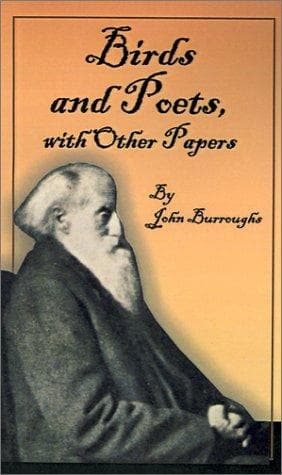
Birds and Poets : with Other PapersBurroughs, John
History
Birds and Poets : with Other Papers
Burroughs, John
American essays -- 19th century; Birds; Natural history -- Outdoor books; Nature
This is perhaps what the German critic, Lessing, really means by
_action,_ for true poems are more like deeds, expressive of something
behind, more like acts of heroism or devotion, or like personal
character, than like thoughts or intellections.
All the master poets have in their work an interior, chemical,
assimilative property, a sort of gastric juice which dissolves thought
and form, and holds in vital fusion religions, times, races, and the
theory of their own construction, naming up with electric and defiant
power,--power without any admixture of resisting form, as in a living
organism.
There are in nature two types or forms, the cell and the crystal.
One means the organic, the other the inorganic; one means growth,
development, life; the other means reaction, solidification, rest. The
hint and model of all creative works is the cell; critical, reflective,
and philosophical works are nearer akin to the crystal; while there
is much good literature that is neither the one nor the other
distinctively, but which in a measure touches and includes both. But
crystallic beauty or cut and polished gems of thought, the result of the
reflex rather than the direct action of the mind, we do not expect to
find in the best poems, though they may be most prized by specially
intellectual persons. In the immortal poems the solids are very few, or
do not appear at all as solids,--as lime and iron,--any more than they
do in organic nature, in the flesh of the peach or the apple. The main
thing in every living organism is the vital fluids: seven tenths of man
is water; and seven tenths of Shakespeare is passion, emotion,--fluid
humanity. Out of this arise his forms, as Venus arose out of the sea,
and as man is daily built up out of the liquids of the body. We cannot
taste, much less assimilate, a solid until it becomes a liquid; and your
great idea, your sermon or moral, lies upon your poem a dead, cumbrous
mass unless there is adequate heat and solvent, emotional power. Herein
I think Wordsworth's "Excursion" fails as a poem. It has too much
solid matter. It is an over-freighted bark that does not ride the waves
buoyantly and lifelike; far less so than Tennyson's "In Memoriam," which
is just as truly a philosophical poem as the "Excursion." (Wordsworth is
the fresher poet; his poems seem really to have been written in the open
air, and to have been brought directly under the oxygenating influence
of outdoor nature; while in Tennyson this influence seems tempered or
farther removed.)
Public-domain text, read in full here on John Shaqi.
Reviews
Reviews
No reviews yet
Be the first to share your thoughts on this work.
Elsewhere in the archive
Join the Discussion
Join the discussion
Sign in to leave a comment or review.
Sign InorCreate an account