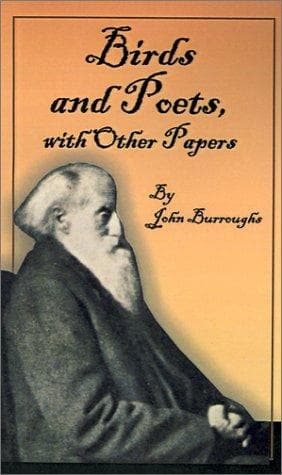
Birds and Poets : with Other PapersBurroughs, John
History
Birds and Poets : with Other Papers
Burroughs, John
American essays -- 19th century; Birds; Natural history -- Outdoor books; Nature
In fact, Emerson is an essence, a condensation; more so, perhaps, than
any other man who has appeared in literature. Nowhere else is there such
a preponderance of pure statement, of the very attar of thought, over
the bulkier, circumstantial, qualifying, or secondary elements. He gives
us net results. He is like those strong artificial fertilizers. A pinch
of him is equivalent to a page or two of Johnson, and he is pitched many
degrees higher as an essayist than even Bacon. He has had an immediate
stimulating effect upon all the best minds of the country; how deep or
lasting this influence will be remains to be seen.
This point and brevity has its convenience and value especially in
certain fields of literature. I by no means would wish to water Emerson;
yet it will not do to lose sight of the fact that mass and inertia are
indispensable to the creator. Considering him as poet alone, I have
no doubt of his irremediable deficiency here. You cannot have broad,
massive effect, deep light and shade, or a torrent of power, with such
extreme refinement and condensation. The superphosphates cannot take the
place of the coarser, bulkier fertilizers. Especially in poetry do
we require pure thought to be well diluted with the human, emotional
qualities. In the writing most precious to the race, how little is
definition and intellectual formula, and how much is impulse, emotion,
will, character, blood, chyle! We must have liquids and gases and
solvents. We perhaps get more of them in Carlyle. Emerson's page
has more serene astral beauty than Carlyle's, but not that intense
blast-furnace heat that melts down the most obdurate facts and
characters into something plastic and poetical. Emerson's ideal is
always the scholar, the man of books and ready wit; Carlyle's hero is a
riding or striding ruler, or a master worker in some active field.
The antique mind no doubt affords the true type of health and wholeness
in this respect. The Greek could see, and feel, and paint, and carve,
and speak nothing but emotional man. In nature he saw nothing but
personality,--nothing but human or superhuman qualities; to him the
elements all took the human shape. Of that vague, spiritual, abstract
something which we call Nature he had no conception. He had no
sentiment, properly speaking, but impulse and will-power. And the
master minds of the world, in proportion to their strength, their spinal
strength, have approximated to this type. Dante, Angelo, Shakespeare,
Byron, Goethe, saw mainly man, and him not abstractly but concretely.
And this is the charm of Burns and the glory of Scott. Carlyle has
written the best histories and biographies of modern times, because he
sees man with such fierce and steadfast eyes. Emerson sees him also,
but he is not interested in him as a man, but mainly as a spirit, as a
demigod, or as a wit or a philosopher.
Public-domain text, read in full here on John Shaqi.
Reviews
Reviews
No reviews yet
Be the first to share your thoughts on this work.
Elsewhere in the archive
Join the Discussion
Join the discussion
Sign in to leave a comment or review.
Sign InorCreate an account