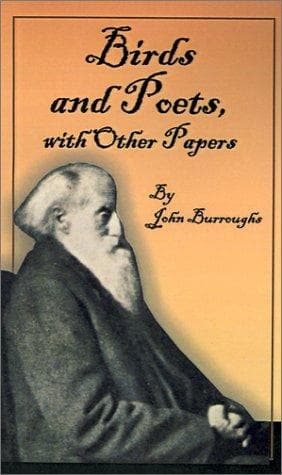
Birds and Poets : with Other PapersBurroughs, John
History
Birds and Poets : with Other Papers
Burroughs, John
American essays -- 19th century; Birds; Natural history -- Outdoor books; Nature
Among the differences between the modern and the classical aesthetic
mind is the greater precision and definiteness of the latter. The
modern genius is Gothic, and demands in art a certain vagueness and
spirituality like that of music, refusing to be grasped and formulated.
Hence for us (and this is undoubtedly an improvement) there must always
be something about a poem, or any work of art, besides the evident
intellect or plot of it, or what is on its surface, or what it tells.
This something is the Invisible, the Undefined, almost Unexpressed,
and is perhaps the best part of any work of art, as it is of a noble
personality. To amuse, to exhibit culture, to formulate the aesthetic,
or even to excite the emotions, is by no means all,--is not even the
deepest part. Beside these, and inclosing all, is the general impalpable
effect, like good air, or the subtle presence of good spirits, wordless
but more potent far than words. As, in the superbest person, it is not
merely what he says or knows or shows, or even how he behaves, but the
silent qualities, like gravitation, that insensibly but resistlessly
hold us; so in a good poem, or in any other expression of art.
IX EMERSON
Wherein the race has so far lost and gained, in being transplanted from
Europe to the New England soil and climate, is well illustrated by the
writings of Emerson. There is greater refinement and sublimation of
thought, greater clearness and sharpness of outline, greater audacity of
statement, but, on the other hand, there is a loss of bulk, of unction,
of adipose tissue, and shall we say of power?
Emerson is undoubtedly a master on the New England scale,--such a master
as the land and race are capable of producing. He stands out clear and
undeniable. The national type, as illustrated by that section of the
country, is the purest and strongest in him of any yet. He can never
suffer eclipse. Compared with the English or German master, he is
undoubtedly deficient in viscera, in moral and intellectual stomach;
but, on the other hand, he is of a fibre and quality hard to match
in any age or land. From first to last he strikes one as something
extremely pure and compact, like a nut or an egg. Great matters and
tendencies lie folded in him, or rather are summarized in his pages. He
writes short but pregnant chapters on great themes, as in his "English
Traits," a book like rich preserves put up pound for pound, a pound
of Emerson to every pound of John Bull. His chapter on Swedenborg in
"Representative Men" is a good sample of his power to abbreviate and
restate with added force. His mind acts like a sun-lens in gathering the
cold pale beams of that luminary to a focus which warms and stimulates
the reader in a surprising manner. The gist of the whole matter is here;
and how much weariness and dullness and plodding is left out!
Public-domain text, read in full here on John Shaqi.
Reviews
Reviews
No reviews yet
Be the first to share your thoughts on this work.
Elsewhere in the archive
Join the Discussion
Join the discussion
Sign in to leave a comment or review.
Sign InorCreate an account