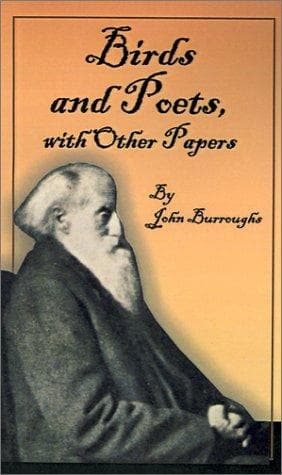
Birds and Poets : with Other PapersBurroughs, John
History
Birds and Poets : with Other Papers
Burroughs, John
American essays -- 19th century; Birds; Natural history -- Outdoor books; Nature
He is a man who occupies every inch of his rightful territory; he is
there in proper person to the farthest bound. Not every man is himself
and his best self at all times and to his finger points. Many great
characters, perhaps the greatest, have more or less neutral or waste
ground. You must penetrate a distance before you reach the real quick.
Or there is a good wide margin of the commonplace which is sure to put
them on good terms with the mass of their fellow-citizens. And one would
think Emerson could afford to relax a little; that he had earned the
right to a dull page or two now and then. The second best or third best
word sometimes would make us appreciate his first best all the more.
Even his god-father Plato nods occasionally, but Emerson's good breeding
will not for a moment permit such a slight to the reader.
Emerson's peculiar quality is very subtle, but very sharp and firm
and unmistakable. It is not analogous to the commoner, slower-going
elements, as heat, air, fire, water, but is nearer akin to that
elusive but potent something we call electricity. It is abrupt, freaky,
unexpected, and always communicates a little wholesome shock. It darts
this way and that, and connects the far and the near in every line.
There is always a leaping thread of light, and there is always a kind
of answering peal or percussion. With what quickness and suddenness
extremes are brought together! The reader is never prepared for what is
to come next; the spark will most likely leap from some source or
fact least thought of. His page seldom glows and burns, but there is a
never-ceasing crackling and discharge of moral and intellectual force
into the mind.
His chief weapon, and one that he never lays down, is identical with
that of the great wits, namely, surprise. The point of his remark or
idea is always sprung upon the reader, never quietly laid before him.
He has a mortal dread of tameness and flatness, and would make the very
water we drink bite the tongue.
He has been from the first a speaker and lecturer, and his style has
been largely modeled according to the demand of those sharp, heady New
England audiences for ceaseless intellectual friction and chafing. Hence
every sentence is braided hard, and more or less knotted, and, though
of silk, makes the mind tingle. He startles by overstatement, by
understatement, by paradox, by antithesis, and by synthesis. Into
every sentence enters the unexpected,--the congruous leaping from the
incongruous, the high coming down, the low springing up, likeness or
relation suddenly coming into view where before was only difference or
antagonism. How he delights to bring the reader up with a short turn,
to impale him on a knotty point, to explode one of his verbal bombshells
under his very nose! Yet there is no trickery or rhetorical legerdemain.
His heroic fibre always saves him.
The language in which Taine describes Bacon applies with even more force
to Emerson:--
Public-domain text, read in full here on John Shaqi.
Reviews
Reviews
No reviews yet
Be the first to share your thoughts on this work.
Elsewhere in the archive
Join the Discussion
Join the discussion
Sign in to leave a comment or review.
Sign InorCreate an account