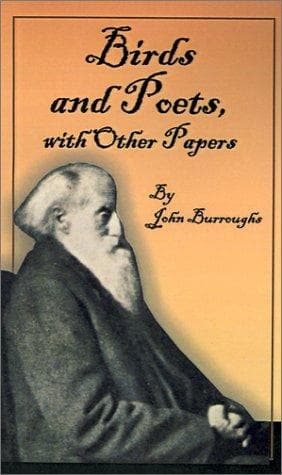
Birds and Poets : with Other PapersBurroughs, John
History
Birds and Poets : with Other Papers
Burroughs, John
American essays -- 19th century; Birds; Natural history -- Outdoor books; Nature
But Emerson makes his point plain, and is not indebted to any of his
teachers for it. It is the burden of all he writes upon the subject. The
long discourse that opens his last volume [footnote: _Letters and Social
Aims_] has numerous subheadings, as "Poetry," "Imagination," "Creation,"
"Morals," and "Transcendency;" but it's all a plea for transcendency. I
am reminded of the story of an old Indian chief who was invited to some
great dinner where the first course was "succotash." When the second
course was ready the old Indian said he would have a little more
succotash, and when the third was ready he called for more succotash and
so with the fourth and fifth, and on to the end. In like manner Emerson
will have nothing but the "spiritual law" in poetry, and he has an
enormous appetite for that. Let him have it, but why should he be so
sure that mankind all want succotash? Mankind finally comes to care
little for what any poet has to _say,_ but only for what he has to
_sing._ We want the pearl of thought dissolved in the wine of life. How
much better are sound bones and a good digestion in poetry than all the
philosophy and transcendentalism in the world!
What one comes at last to want is power, mastery; and, whether it be
mastery over the subtleties of the intellect, as in Emerson himself, or
over the passions and the springs of action, as in Shakespeare, or over
our terrors and the awful hobgoblins of hell and Satan, as in Dante, or
over vast masses and spaces of nature and the abysms of aboriginal man,
as in Walt Whitman, what matters it? Are we not refreshed by all? There
is one mastery in Burns, another in Byron, another in Rabelais, and in
Victor Hugo, and in Tennyson; and though the critic has his preferences,
though he affect one more than another, yet who shall say this one is
a poet and that one is not? "There may be any number of supremes," says
the master, and "one by no means contravenes another." Every gas is
a vacuum to every other gas, says Emerson, quoting the scientist; and
every great poet complements and leaves the world free to every other
great poet.
Emerson's limitation or fixity is seen also in the fact that he has
taken no new step in his own direction, if indeed another step could be
taken in that direction and not step off. He is a prisoner on his
peak. He cannot get away from the old themes. His later essays are
upon essentially the same subjects as his first. He began by writing
on nature, greatness, manners, art, poetry, and he is still writing on
them. He is a husbandman who practices no rotation of crops, but submits
to the exhaustive process of taking about the same things from his soil
year after year. Some readers think they detect a falling off. It is
evident there is not the same spontaneity, and that the soil has to be
more and more stirred and encouraged, which is not at all to be wondered
at.
Public-domain text, read in full here on John Shaqi.
Reviews
Reviews
No reviews yet
Be the first to share your thoughts on this work.
Elsewhere in the archive
Join the Discussion
Join the discussion
Sign in to leave a comment or review.
Sign InorCreate an account