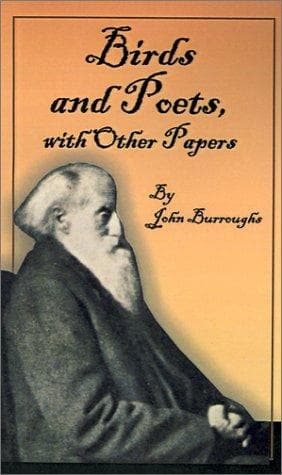
Birds and Poets : with Other PapersBurroughs, John
History
Birds and Poets : with Other Papers
Burroughs, John
American essays -- 19th century; Birds; Natural history -- Outdoor books; Nature
He stands among other poets like a pine-tree amid a forest of oak and
maple. He seems to belong to another race, and to other climes and
conditions. He is great in one direction, up; no dancing leaves, but
rapt needles; never abandonment, never a tossing and careering, never
an avalanche of emotion; the same in sun and snow, scattering his cones,
and with night and obscurity amid his branches. He is moral first and
last, and it is through his impassioned and poetic treatment of the
moral law that he gains such an ascendency over his reader. He says, as
for other things he makes poetry of them, but the moral law makes poetry
of him. He sees in the world only the ethical, but he sees it through
the aesthetic faculty. Hence his page has the double charm of the
beautiful and the good.
II
One of the penalties Emerson pays for his sharp decision, his mental
pertinence and resistance, is the curtailment of his field of vision and
enjoyment. He is one of those men whom the gods drive with blinders on,
so that they see fiercely in only a few directions. Supreme lover as he
is of poetry,--Herrick's poetry,--yet from the whole domain of what may
be called emotional poetry, the poetry of fluid humanity, tallied by
music, he seems to be shut out. This may be seen by his reference
to Shelley in his last book, "Letters and Social Aims," and by
his preference of the metaphysical poet throughout his writings.
Wordsworth's famous "Ode" is, he says, the high-water mark of English
literature. What he seems to value most in Shakespeare is the marvelous
wit, the pregnant sayings. He finds no poet in France, and in his
"English Traits" credits Tennyson with little but melody and color. (In
our last readings, do we not surely come to feel the manly and robust
fibre beneath Tennyson's silken vestments?) He demands of poetry that
it be a kind of spiritual manna, and is at last forced to confess that
there are no poets, and that when such angels do appear, Homer and
Milton will be tin pans.
One feels that this will not do, and that health, and wholeness, and
the well-being of man are more in the keeping of Shakespeare than in the
hands of Zoroaster or any of the saints. I doubt if that rarefied air
will make good red blood and plenty of it.
Public-domain text, read in full here on John Shaqi.
Reviews
Reviews
No reviews yet
Be the first to share your thoughts on this work.
Elsewhere in the archive
Join the Discussion
Join the discussion
Sign in to leave a comment or review.
Sign InorCreate an account