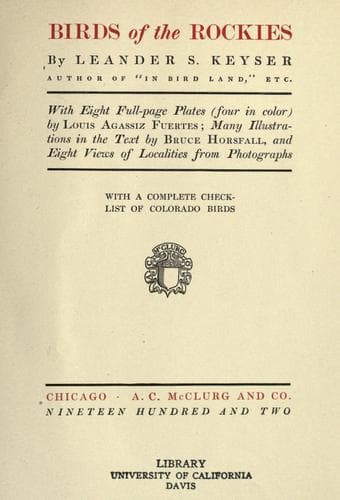
Birds of the RockiesKeyser, Leander S. (Leander Sylvester)
History
Birds of the Rockies
Keyser, Leander S. (Leander Sylvester)
Birds; Birds -- Colorado
As one of these minstrels sat on a flowering weed and gave himself up
to a lyrical transport, I made careful notes, and now give the substance
of my elaborate entries. The song, which is intermittent, opens with
three prolonged notes running high in the scale, and is succeeded by a
quaint, rattling trill of an indescribable character, not without
musical effect, which is followed by three double-toned long notes quite
different from the opening phrases; then the whole performance is closed
by an exceedingly high and fine run like an insect's hum--so fine,
indeed, that the auditor must be near at hand to notice it at all.
Sometimes the latter half of the score, including the second triad of
long notes, is repeated before the soloist stops to take breath. It will
be seen that the regular song consists of four distinct phrases, two
triads and two trills. About one-third of the songs are opened in a
little lower key than the rest, the remainder being correspondingly
mellowed. The opening syllables, and, indeed, some other parts of the
melody as well, are very like certain strains of the song-sparrow, both
in execution and in quality of tone; and thus even the experienced
ornithologist may sometimes be led astray. When the bunting sails into
the air, he rehearses the song just described, only he is very likely to
prolong it by repeating the various parts, though I think he seldom, if
ever, throws them together in a hodge-podge. He seems to follow a system
in his recitals, varied as many of them are. As to his voice, it is of
superb timbre.
Another characteristic noted was that the buntings do not throw back
their heads while singing, after the manner of the sparrows, but stretch
their necks forward, and at no time do they open their mouths widely. As
a rule, or at least very often, when flying, they do not begin their
songs until they have almost reached the apex of their triangle; then
the song begins, and it continues over the angle and down the incline
until another perch is settled upon. What Lowell says of "bobolinkum" is
just as true of bunting--"He runs down, a brook o' laughter, thru the
air." As the sun went down behind the snow-clad mountains, a half dozen
or more of the buntings rolled up the full tide of song, and I left them
to their vespers and trudged back to the village, satisfied with the
acquirements of this red-letter day in my ornithological journey.
Public-domain text, read in full here on John Shaqi.
Reviews
Reviews
No reviews yet
Be the first to share your thoughts on this work.
Elsewhere in the archive
Join the Discussion
Join the discussion
Sign in to leave a comment or review.
Sign InorCreate an account