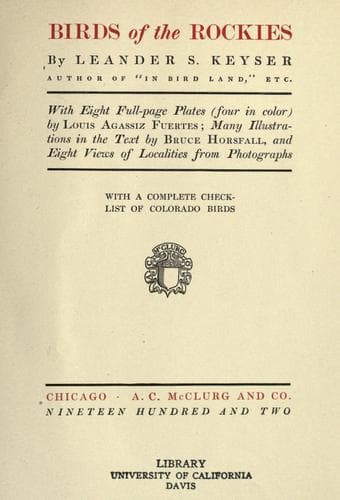
Birds of the RockiesKeyser, Leander S. (Leander Sylvester)
History
Birds of the Rockies
Keyser, Leander S. (Leander Sylvester)
Birds; Birds -- Colorado
However, one afternoon's study of such charming birds was not enough to
satisfy my curiosity, for no females had been seen and no nests
discovered. About ten days later, more attention was given them. In a
meadow not far from the hamlet of Arvada, between Denver and the
mountains, I found a colony of buntings one morning, swinging in the air
and furnishing their full quota of the matutinal concert, in which many
other birds had a leading part, among them being western meadow-larks,
western robins, Bullock's orioles, American and Arkansas goldfinches,
mountain song-sparrows, lazuli finches, spurred towhees, black-headed
grosbeaks, summer warblers, western Maryland yellow-throats, and
Townsend's solitaires. It has seldom been my fortune to listen to a
finer _pot-pourri_ of avian music.
At first only male buntings were seen. Surely, I thought, there must be
females in the neighborhood, for when male birds are singing so lustily
about a place, their spouses are usually sitting quietly on nests
somewhere in bush or tree or grass. I hunted long for a nest, trudging
about over the meadow, examining many a grass-tuft and weed-clump,
hoping to flush a female and discover her secret; but my quest was vain.
It is strange how difficult it is to find nests in Colorado, either on
the plains or in the mountains. The birds seem to be adepts in the fine
arts of concealment and secret-keeping. Presently several females were
seen flying off over the fields and returning, obviously to feed their
young. There was now some colorable prospect of finding a nest. A mother
bird appeared with a worm in her bill, and you may rely upon it I did
not permit her to slip from my sight until I saw her drop to the ground,
hop about stealthily for a few moments, then disappear, and presently
fly up minus the worm. Scarcely daring to breathe, I followed a direct
course to the weed-clump from which she had risen. And there was a nest,
sure enough--my first lark bunting's--set in a shallow pit of the
ground, prettily concealed and partly roofed over by the flat and
spreading weed-stalk. Four half-fledged youngsters lay panting in the
little cradle, the day being very warm. I lifted one of them from the
nest, and held it in my hand for a minute or two, and even touched it
with my lips, my first view of lark-bunting babies being something of an
event--I had almost said an epoch--in my experience. Replacing the
youngster in its crib, I stepped back a short distance and watched the
mother bird returning with another mouthful of "goodies," and feeding
her bantlings four. She was not very shy, and simply uttered a fine
chirp when I went too close to her nestlings, while her gallant consort
did not even chirp, but tried to divert my attention by repeatedly
curveting in the air and singing his choicest measures. This was the
only bunting's nest I found, although I made long and diligent search
for others, as you may well believe when I state that a half day was
Public-domain text, read in full here on John Shaqi.
Reviews
Reviews
No reviews yet
Be the first to share your thoughts on this work.
Elsewhere in the archive
Join the Discussion
Join the discussion
Sign in to leave a comment or review.
Sign InorCreate an account