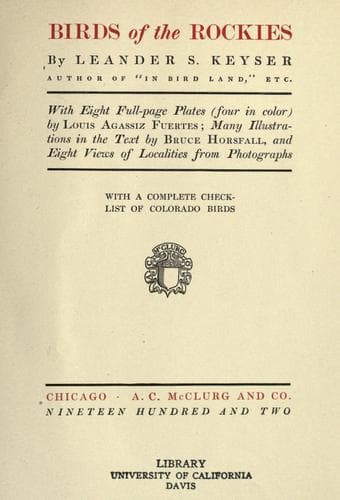
Birds of the RockiesKeyser, Leander S. (Leander Sylvester)
History
Birds of the Rockies
Keyser, Leander S. (Leander Sylvester)
Birds; Birds -- Colorado
these birds should avoid the copsy swamps near Moraine Lake, and yet
select for breeding homes the valleys both above and below it. Perhaps
the valley of Moraine Lake is a little too secluded and shut in by the
towering mountains on three sides, the other places being more open and
sunshiny.
The upper valley was the summer home of that musician _par excellence_
of the Rockies, the green-tailed towhee, and he sang most divinely,
pouring out his
"full heart
In profuse strains of unpremeditated art."
Having elsewhere described his minstrelsy and habits with more or less
fulness, I need give him only this passing reference here. A little bird
with which I here first made acquaintance was an elegant species known
as Audubon's warbler, which may be regarded as the western
representative of the myrtle warbler of the East. The two birds are
almost counterparts. Indeed, at first I mistook the Audubon for the
myrtle. The former has a yellow throat, while the latter's throat is
white.
In all the upper mountain valleys, and on the steep slopes of the
western as well as the eastern side of the Divide, I had the Audubon
warblers often at my elbow. In summer they make their homes at an
altitude of seven to eleven thousand feet, and are partial to pine
timber; indeed, I think I never found them elsewhere, save occasionally
among the quaking asps. I learned to distinguish Audubon's chanson from
those of his fellow-minstrels. It is not much of a song--a rather weak
little trill, with a kind of drawl in the vocalization that forms its
diagnostic feature. The persistency with which it is repeated on the
solitary pine-clad mountain sides constitutes its principal charm.
The winter haunts of Audubon's warblers are farther south than Colorado,
mostly in Mexico and Guatemala, although a few of them remain in the
sheltered mountain valleys of the western part of the United States.
Early in May they appear on the plains of eastern Colorado, where they
are known only as migrants. Here a double movement presently takes
place--what might be called a longitudinal and a vertical migration--one
division of the warbler army sweeping north to their breeding grounds in
Canada, and the other wheeling westward and ascending to the alpine
heights among the mountains, where they find the subartic conditions
that are congenial to their natures without travelling so great a
distance. Here they build their nests in the pine or spruce trees, rear
their families, and as autumn approaches, descend to the plains, tarry
there a week or two, then hie to their winter homes in the South.
Public-domain text, read in full here on John Shaqi.
Reviews
Reviews
No reviews yet
Be the first to share your thoughts on this work.
Join the Discussion
Join the discussion
Sign in to leave a comment or review.
Sign InorCreate an account