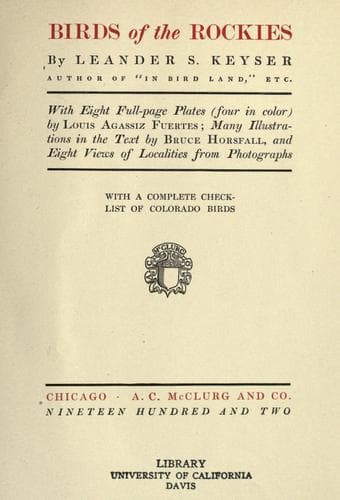
Birds of the RockiesKeyser, Leander S. (Leander Sylvester)
History
Birds of the Rockies
Keyser, Leander S. (Leander Sylvester)
Birds; Birds -- Colorado
Sometimes these birds are called shore larks; but that is evidently a
misnomer, or at least a very inapt name, for they are not in the least
partial to the sea-shore or even the shores of lakes, but are more
disposed to take up their residence in inland and comparatively dry
regions. There are several varieties, all bearing a very close
resemblance, so close, indeed, that only an expert ornithologist can
distinguish them, even with the birds in hand. The common horned lark is
well known in the eastern part of the United States as a winter
resident, while in the middle West, Missouri, Kansas, Nebraska, etc.,
are to be found the prairie horned larks, which, as their name
indicates, choose the open prairie for their home. The desert horned
larks are tenants exclusively of the arid plains, mesas, and mountain
parks of the West. There is still another variety, called the pallid
horned lark, which spends the winter in Colorado, then hies himself
farther north in summer to rear his brood.
As I pursued my walk, one of these birds suddenly assumed an alert
attitude, then darted into the air, mounting up, up, up, in a series of
swift leaps, like "an embodied joy whose race has just begun." Up he
soared until he could no longer be seen with the naked eye, and even
through my field-glass he was a mere speck against the blue canopy, and
yet, high as he had gone, his ditty filtered down to me through the
still, rarefied atmosphere, like a sifting of fine sand. His descent was
a grand plunge, made with the swiftness of an Indian's arrow, his head
bent downward, his wings partly folded, and his tail perked upward at
precisely the proper angle to make a rudder, all the various organs so
finely adjusted as to convert him into a perfectly dirigible parachute.
Swift as his descent was, he alighted on the ground as lightly as a tuft
of down. It was the poetry of motion. One or two writers have insisted
that the horned lark's empyrean song compares favorably with that of
the European skylark; but, loyal and patriotic an American as we are,
honesty compels us to concede that our bird's voice is much feebler and
less musical than that of his celebrated relative across the sea. It
sounds like the unmelodious clicking of pebbles, while the song of the
skylark is loud, clear, and ringing.
Public-domain text, read in full here on John Shaqi.
Reviews
Reviews
No reviews yet
Be the first to share your thoughts on this work.
Join the Discussion
Join the discussion
Sign in to leave a comment or review.
Sign InorCreate an account