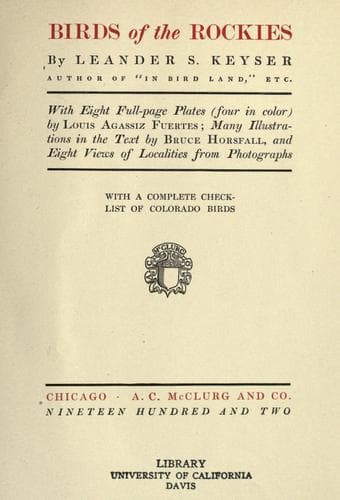
Birds of the RockiesKeyser, Leander S. (Leander Sylvester)
History
Birds of the Rockies
Keyser, Leander S. (Leander Sylvester)
Birds; Birds -- Colorado
In studying the birds of the West, one should note that there are
western subspecies and varieties, which differ in some respects, though
not materially, from their eastern cousins; for instance, the western
robin, the western chipping sparrow, the western lark sparrow, and the
western nighthawk. Besides, intermediate forms are to be met with and
classified, the eastern types shading off in a very interesting process
into the western. It would be impossible for any one but a systematist
with the birds in hand to determine where the intermediate forms become
either typical easterners or typical westerners.
Most interesting of all to the rambler on avian lore intent is the fact
that there are many species and genera that are peculiar to the West,
and therefore new to him, keeping him constantly on the _qui vive_. In
Colorado you will look in vain for the common blue jay, so abundant in
all parts of the East; but you will be more than compensated by the
presence of seven other species of the jay household. The woodpeckers of
the West (with one exception) are different from those of the East, and
so are the flycatchers, the grosbeaks, the orioles, the tanagers, the
humming-birds, and many of the sparrows. Instead of the purple and
bronzed grackles (the latter are sometimes seen on the plains of
Colorado, but are not common), the Rockies boast of Brewer's blackbird,
whose habits are not as prosaic as his name would indicate. "Jim Crow"
shuns the mountains for reasons satisfactory to himself; not so the
magpie, the raven, and that mischief-maker, Clark's nutcracker. All of
which keeps the bird-lover from the East in an ecstasy of surprises
until he has become accustomed to his changed environment.
One cannot help falling into the speculative mood in view of the sharp
contrasts between the birds of the East and those of the West. Why does
the hardy and almost ubiquitous blue jay studiously avoid the western
plains and mountains? Why do not the magpie and the long-crested jay
come east? What is there that prevents the indigo-bird from taking up
residence in Colorado, where his pretty western cousin, the lazuli
finch, finds himself so much at home? Why is the yellow-shafted flicker
of the East replaced in the West by the red-shafted flicker? These
questions are more easily asked than answered. From the writer's present
home in eastern Kansas it is only six hundred miles to the foot of the
Rockies; yet the avi-fauna of eastern Kansas is much more like that of
the Eastern and New England States than that of the Colorado region.
Public-domain text, read in full here on John Shaqi.
Reviews
Reviews
No reviews yet
Be the first to share your thoughts on this work.
Join the Discussion
Join the discussion
Sign in to leave a comment or review.
Sign InorCreate an account