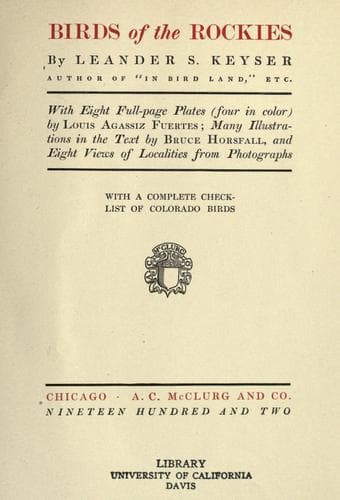
Birds of the RockiesKeyser, Leander S. (Leander Sylvester)
History
Birds of the Rockies
Keyser, Leander S. (Leander Sylvester)
Birds; Birds -- Colorado
But let me pause to pay a little tribute to the brave robin redbreast.
Of course, here he is called the "western robin." His distribution is an
interesting scientific fact. I found him everywhere--on the arid plains
and mesas, in the solemn pines of the deep gulches and passes, and among
the scraggy trees bordering on timber-line, over ten thousand feet above
sea-level. In Colorado the robins are designated as "western," forms by
the system-makers, but, even though called by a modified title, they
deport themselves, build their nests, and sing their "cheerily,
cheerily, cheer up," just as do their brothers and sisters of the land
toward the rising sun. If there is any difference, their songs are not
so loud and ringing, and their breasts not quite so ruddy as are those
of the eastern types. Perhaps the incessant sunshine of Colorado
bleaches out the tints somewhat.
But in my ante-breakfast stroll at Manitou I soon stumbled upon
feathered strangers. What was this little square-shouldered bird that
kept uttering a shrill scream, which he seemed to mistake for a song? It
was the western wood-pewee. Instead of piping the sweet, pensive
"Pe-e-e-o-we-e-e-e" of the woodland bird of the Eastern States, this
western swain persists in ringing the changes hour by hour upon that
piercing scream, which sounds more like a cry of anguish than a song. At
Buena Vista, where these birds are superabundant, their morning concerts
were positively painful. One thing must be said, however, in defence of
the western wood-pewee--he means well.
Another acquaintance of my morning saunter was the debonair Arkansas
goldfinch, which has received its bunglesome name, not from the State of
Arkansas, but from the Arkansas River, dashing down from the mountains
and flowing eastwardly through the southern part of Colorado. Most
nattily this little bird wears his black cap, his olive-green frock,
and his bright yellow vest. You will see at once that he dresses
differently from the American goldfinch, so well known in the East, and,
for that matter, just as well known on the plains of Colorado, where
both species dwell in harmony. There are some white markings on the
wings of _Spinus psaltria_ that give them a gauze-like appearance when
they are rapidly fluttered.
His song and some of his calls bear a close resemblance to those of the
common goldfinch, but he is by no means a mere duplicate of that bird;
he has an individuality of his own. While his flight is undulatory, the
waviness is not so deeply and distinctly marked; nor does he sing a
cheery cradle-song while swinging through the ether, although he often
utters a series of unmusical chirps. One of the most pleasingly pensive
sounds heard in my western rambles was the little coaxing call of this
bird, whistled mostly by the female, I think. No doubt it is the tender
love talk of a young wife or mother, which may account for its
surpassing sweetness.
Public-domain text, read in full here on John Shaqi.
Reviews
Reviews
No reviews yet
Be the first to share your thoughts on this work.
Join the Discussion
Join the discussion
Sign in to leave a comment or review.
Sign InorCreate an account