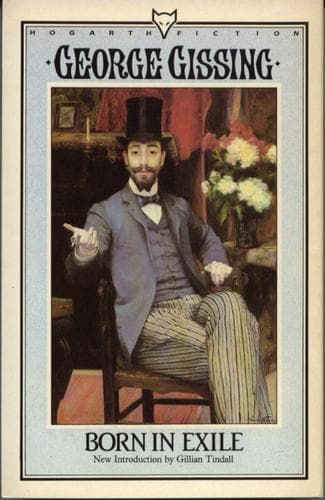
England -- Social life and customs -- 19th century -- Fiction; English fiction -- 19th century
Already they had discussed in detail the first half of the book. How a
man of Mr. Warricombe's intelligence could take grave interest in an
arid exegesis of the first chapter of Genesis, Godwin strove in vain to
comprehend. Often enough the debates were perilously suggestive of
burlesque, and, when alone, he relieved himself of the laughter he had
scarce restrained. For instance, there was that terrible _thohu wabohu_
of the second verse, a phrase preserved from the original, and tossed
into all the corners of controversy. Was _thohu wabohu_ the first
condition of the earth, or was it merely a period of division between a
previous state of things and creation as established by the Hexaemeron?
Did light exist or not, previous to the _thohu wabohu_? Then, again,
what kind of 'days' were the three which passed before the birth of the
sun? Special interest, of course, attached to the successive theories
of theology on the origin of geologic strata. First came the 'theory of
restitution', which explained unbiblical antiquity by declaring that
the strata belonged to a world before the Hexaemeron, a world which had
been destroyed, and succeeded by the new creation. Less objectionable
was the 'concordistic theory', which interprets the 'six days' as so
many vast periods of creative activity. But Reusch himself gave
preference to the 'ideal theory', the supporters whereof (diligently
adapting themselves to the progress of science) hold that the six days
are not to be understood as consecutive periods at all, but merely as
six phases of the Creator's work.
By the exercise of watchfulness and dexterity, Peak managed for the
most part to avoid expression of definite opinions. His attitude was
that of a reverent (not yet reverend) student. Mr. Warricombe was less
guarded, and sometimes allowed himself to profess that he saw nothing
but vain ingenuity in Reusch's argument: as, for example, where the
theologian, convinced that the patriarchs did really live to an
abnormal age, suggests that man's life was subsequently shortened in
order that 'sin might not flourish with such exuberance'. This passage
caused Martin to smile.
'It won't do, it won't do,' he said, quietly. 'Far better apply his
rationalism here as elsewhere. These are wonderful old stories, not to
be understood literally. Nothing depends upon them, nothing essential.'
Public-domain text, read in full here on John Shaqi.
Reviews
Reviews
No reviews yet
Be the first to share your thoughts on this work.
Elsewhere in the archive
Join the Discussion
Join the discussion
Sign in to leave a comment or review.
Sign InorCreate an account