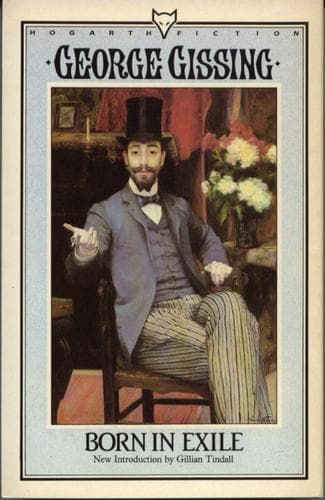
England -- Social life and customs -- 19th century -- Fiction; English fiction -- 19th century
All very well, if the question signified, in what way to provide for
the healthy development of his manhood. Of course it meant nothing of
the sort, but merely: What work can be found for him whereby he may
earn his daily bread? We--his kinsfolk even, not to think of the world
at large--can have no concern with his growth as an intellectual being;
we are hard pressed to supply our own mouths with food; and now that we
have done our recognised duty by him, it is high time that he learnt to
fight for his own share of provender. Happily, he is of the robust sex;
he can hit out right and left, and make standing-room. We have armed
him with serviceable weapons, and now he must use them against the
enemy--that is to say, against all mankind, who will quickly enough
deprive him of sustenance if he fail in the conflict. We neither know,
nor in great measure care, for what employment he is naturally marked.
Obviously he cannot heave coals or sell dogs' meat, but with negative
certainty not much else can be resolved, seeing how desperate is the
competition for minimum salaries. He has been born, and he must eat. By
what licensed channel may he procure the necessary viands?
Paternal relatives Godwin had as good as none. In quitting London,
Nicholas Peak had ceased to hold communication with any of his own
stock save the younger brother Andrew. With him he occasionally
exchanged a letter, but Andrew's share in the correspondence was
limited to ungrammatical and often unintelligible hints of numerous
projects for money-making. Just after the removal of the bereaved
family to Twybridge, they were surprised by a visit from Andrew, in
answer to one of whose letters Mrs. Peak had sent news of her husband's
death. Though her dislike of the man amounted to loathing, the widow
could not refuse him hospitality; she did her best, however, to prevent
his coming in contact with anyone she knew. Andrew declared that he was
at length prospering; he had started a coffee-shop at Dalston, in
north-east London, and positively urged a proposal (well-meant, beyond
doubt) that Godwin should be allowed to come to him and learn the
business. Since then the Londoner had once again visited Twybridge,
towards the end of Godwin's last school-year. This time he spoke of
himself less hopefully, and declared a wish to transfer his business to
some provincial town, where he thought his metropolitan experience
might be of great value, in the absence of serious competition. It was
not difficult to discover a family likeness between Andrew's
instability and the idealism which had proved the ruin of Nicholas.
Public-domain text, read in full here on John Shaqi.
Reviews
Reviews
No reviews yet
Be the first to share your thoughts on this work.
Join the Discussion
Join the discussion
Sign in to leave a comment or review.
Sign InorCreate an account