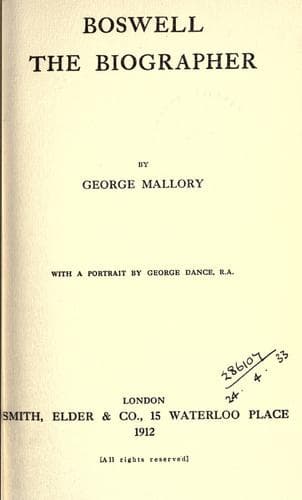
Authors, Scottish -- 18th century -- Biography; Biographers -- Great Britain -- Biography; Boswell, James, 1740-1795
This ludicrous exhibition was much talked of and laughed at.
To heighten the absurdity, his Liberal friends affected to be
shocked at his want of principle, in singing praises of the
'Grocer,' whom he had been heard to abuse. They were enchanted
to find him rise to the bait, and thus vindicate himself:
'Pray let them know that I am vain of a hasty composition
which has procured me large draughts of the popular applause
in which I delight. Let me add that there was certainly no
servility on my part, for I publicly declared in Guildhall,
between the encores, "that this same Grocer had treated me
arrogantly and ungratefully, but that, from his great merit
as a minister, I was compelled to support him." The time will
come when I shall have a riper opportunity to show, that in
one instance, at least, the man has wanted wisdom.'
He goes on to explain that Boswell gained a good deal of notoriety
from the escapade, which was alluded to in a popular satirical poem of
the time.
It is easy indeed to understand the motives of Boswell. His childish
and unrestrained love of merriment, his insatiable desire to be the
wag and the buffoon, enabled him to give vent in the most mirthful
fashion to his passion for self-advertisement, to explain how he had
been honoured by the attention of kings and how he intended to have
an introduction to the great Minister; and with all this he retained a
certain fundamental honesty about himself, so that he was compelled
to exclaim between the encores 'that this same Minister had treated
me arrogantly and ungratefully.' He understood so little what was the
opinion of the company about him that he seems to have believed that
he was recommending himself to a patron, and he was so vain that he
was undoubtedly proud of what must have been an absurd composition.
Boswell indeed was very fond of writing humorous verse.[35] The
instinct in him was the natural result of his animal spirits; the need
to be laughing, which he felt so strongly at most times when he was
not depressed and melancholy, fixed upon the smallest objects as
suitable for his wit, and he was satisfied only by some form of
expression. The reason that he collected in his commonplace-book a
number of 'good things,' as he would call them, is not so much that he
was proud of his own sayings (for those of others are also treasured)
or that he wished to preserve them for posterity, though both these
feelings were present, as that his huge enjoyment of anything witty
must be recorded to be satisfied.
Public-domain text, read in full here on John Shaqi.
Reviews
Reviews
No reviews yet
Be the first to share your thoughts on this work.
Elsewhere in the archive
Join the Discussion
Join the discussion
Sign in to leave a comment or review.
Sign InorCreate an account