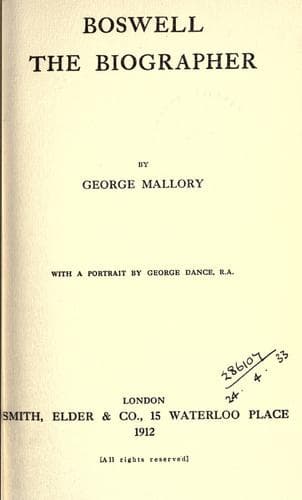
Authors, Scottish -- 18th century -- Biography; Biographers -- Great Britain -- Biography; Boswell, James, 1740-1795
It is remarkable, when we recollect what a large sense of humour he
had, that many of his verses and of his jokes should be so dull and
colourless. But the faculty for appreciating what is amusing is very
different from the capacity for originating it. It is the difference
between humour and wit. The latter involves the power of expression;
and a man may as easily be full of humour, without making a joke, as
he may be by nature a poet without ever writing a line of good poetry.
Boswell had some wit, but not very much--far less than anyone would
imagine merely from reading the 'Life' or the 'Tour.' His position
perhaps is not unlike that of several poets who have written some
stanzas and stray lines of a rare beauty, and are none the less poets
because they have written also much that seems quite unpoetical.
A specimen of Boswell's humorous verse is printed in the 'Life.' He
had dined one evening at Lord Montrose's and afterwards went to Miss
Monckton's, where 'a great number of persons of the first rank' were
assembled, in a state of improper elevation. 'Next day,' says Boswell,
'I endeavoured to give what had happened the most ingenious turn I
could, by the following verses:
Not that with th' excellent Montrose
I had the happiness to dine;
Not that I late from table rose,
From Graham's wit, from generous wine.
It was not these alone which led
On sacred manners to encroach;
And made me feel what most I dread,
Johnson's just frown, and self-reproach.
But when I entered, not abash'd,
From your bright eyes were shot such rays,
At once intoxication flash'd,
And all my frame was in a blaze:
But not a brilliant blaze I own,
Of the dull smoke I'm yet asham'd;
I was a dreary ruin grown,
And not enlighten'd though enflam'd.
Victim at once to wine and love,
I hope, Maria, you'll forgive;
While I invoke the powers above,
That henceforth I may wiser live.
Certainly this is amusing in some degree, and amusing too in an
original way; but much of it is mere rhyming without any sort of wit.
Boswell could be as banal as anyone. An ode ('Horatian Ode,' he calls
it) to Charles Dilly, which is chiefly concerned with one Dr. Lettsom,
frequently the host of both Boswell and Dilly, exhibits the author of
humorous verse at his worst; it will be enough to quote one stanza:
And guests has he in ev'ry degree
Of decent estimation.
His liberal mind holds all mankind,
As an extended nation.
Public-domain text, read in full here on John Shaqi.
Reviews
Reviews
No reviews yet
Be the first to share your thoughts on this work.
Elsewhere in the archive
Join the Discussion
Join the discussion
Sign in to leave a comment or review.
Sign InorCreate an account