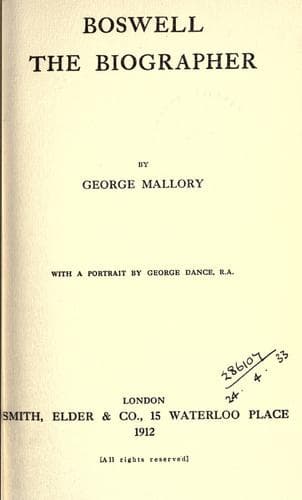
Authors, Scottish -- 18th century -- Biography; Biographers -- Great Britain -- Biography; Boswell, James, 1740-1795
Boswell's _mots_ are of a common eighteenth-century type. The turn
of phrase admired by both Johnson and Boswell and most of their
contemporaries was the image. In 'Boswelliana' is a story of Boswell's
introduction to Scotch lawyers: 'Boswell had a great aversion to the
law, but forced himself to enter upon that laborious profession in
compliance with the anxious desire of his father, for whom he had the
greatest regard. After putting on the gown he said with great good
humour to his brother advocates, 'Gentlemen, I am prest into the
service here; but I have observed that a prest man, either by sea or
land, after a little time does just as well as a volunteer.'
That is Boswell at his best.
Here is another specimen of Boswell's wit: 'A modern man of taste
found fault with the avenues at Auchinleck, and said he wished to
see straggling trees. 'I wish,' said Boswell, 'I could see straggling
fools in this world.'
That is Boswell at his worst.
Why a man who had so much natural humour as Boswell had should have
failed so completely to discriminate when his own wit was in question
must remain as much a problem to us as is the failure of many a poet
to criticise his own writings--the explanation may be perhaps that it
requires some special effort of the mind which can but rarely be
made and which is impossible after the moment of composition. Boswell
certainly seems to have had a high opinion of his efforts to be witty;
his verses to Miss Monckton are inserted in the 'Life' with evident
pride, and without any excuse of some connection with Johnson such as
he usually makes when alluding to his own performances, and he seems
frequently to have sung the songs which he composed, obtaining, no
doubt, in this way the 'conspicuousness' which he desired.[36]
The enjoyment which Boswell had in public at Stratford and at the
mayoralty dinner and in private, no doubt, on many occasions of which
unfortunately we have no account, is perhaps best illustrated and best
understood from a single sentence of his own in one of the 'Letters to
Temple':
I was the great man (as we used to say) at the late
Drawing-Room, in a suit of imperial blue lined with
rose-coloured silk, and ornamented with rich gold-wrought
buttons.
For the eagerness which Boswell had to reveal to others anything about
himself which he was proud of, and a sort of inevitable obtrusiveness
in him, Johnson with his usual shrewdness found an excellent parallel
which is faithfully recounted in the 'Life':
Once when checking my boasting too frequently of myself in
company, he said to me, 'Boswell, you often vaunt so much
as to provoke ridicule. You put me in mind of a man who was
standing in the kitchen of an inn with his back to the fire,
and thus accosted the person next him, "Do you know, sir,
who I am?" "No, sir," said the other, "I have not that
advantage." "Sir," said he, "I am the _great Twalmley_, who
invented the New Floodgate Iron."'
Public-domain text, read in full here on John Shaqi.
Reviews
Reviews
No reviews yet
Be the first to share your thoughts on this work.
Elsewhere in the archive
Join the Discussion
Join the discussion
Sign in to leave a comment or review.
Sign InorCreate an account