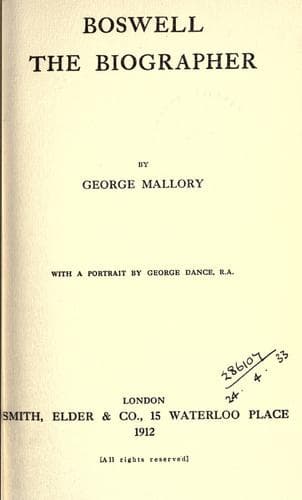
Authors, Scottish -- 18th century -- Biography; Biographers -- Great Britain -- Biography; Boswell, James, 1740-1795
When Boswell says that he is unwilling to give pain we may believe
him unreservedly; there may have been particular cases when he lowered
himself to the satisfaction of a grudge, but as a general statement
it is true. That Boswell was good-natured is incontestable: it is
admitted on all hands. 'Good-nature,' wrote Mr. Courtenay, 'was highly
predominant in his character. He appeared to entertain sentiments of
benevolence to all mankind, and it does not appear to me that he ever
did, or could, injure any human being _intentionally_.' Mr. Malone
wrote a letter for the _Gentleman's Magazine_ vindicating Boswell's
character after his death. 'He had not only an inexhaustible fund
of good-humour and good-nature, but was extremely warm in his
attachments, and as ready to exert himself for his friends as any
man.' His untiring kindness to Johnson might perhaps be refused as
evidence that he was 'ready to exert himself for his friends.' Towards
Temple and his wife also, from whom he had nothing to gain, 'he always
played,' as Mr. Seccombe remarks, 'a very friendly part'; 'he made
Johnson known to them, for instance; he took Paoli down to Mamhead,
he had Temple up to town and took him and his daughter to Westminster
Hall to see the trial of Warren Hastings. He took them more than once
to Sir Joshua's studio in Leicester Square, he acted as godfather to
one of the sons, and tipped another who was at Eton.' But the most
remarkable testimony that Boswell had, as the French say, _le c[oe]ur
bon_ is his will. We shall have to pay some attention to this
document in a later chapter: it shows that Boswell could be remarkably
considerate.
Boswell wrote and published the 'Tour' with a greedy enjoyment
and uncontained expansiveness entirely typical of him, and in
amazing ignorance of some of the strongest human feelings--of the
proprietorship that men feel with respect to their own lives which
surrounds them with a sacred halo of privacy, and of their inordinate
desire to appear more virtuous and more successful than they are. He
babbled of himself as he babbled of others, not unconscious of the
folly that he committed and revealed, but not suspecting that he would
be called a fool for admitting his folly. Truth, as these pages have
already remarked, was of supreme importance to Boswell, and was not to
be suppressed. He could hardly understand that plain fact could hurt
anyone. A pamphleteer who wished to make Boswell ridiculous has
suggested his attitude in a picturesque manner: Lord Macdonald is
supposed to be threatening personal violence; Walcot writes:
Treat with contempt the menace of this Lord.
'Tis Hist'ry's province, Bozzy, to record.
There was fundamentally in Boswell's nature a desire to record
observations--a desire which overrode his conventional aims and
ambitions and, while decreasing the possibility of his being a
successful man, made it certain that he would be a great one.
Public-domain text, read in full here on John Shaqi.
Reviews
Reviews
No reviews yet
Be the first to share your thoughts on this work.
Elsewhere in the archive
Join the Discussion
Join the discussion
Sign in to leave a comment or review.
Sign InorCreate an account