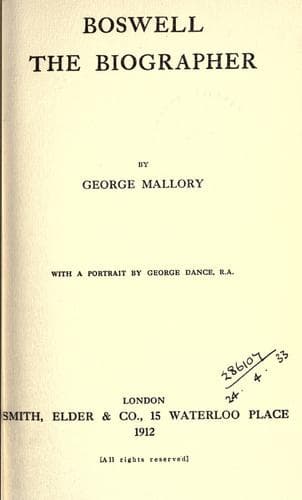
Authors, Scottish -- 18th century -- Biography; Biographers -- Great Britain -- Biography; Boswell, James, 1740-1795
All that Boswell meant by truth will be examined later in connection
with his biographical method. 'The Journal of a Tour to the Hebrides'
must be criticised as a book along with the 'Life of Johnson' and not
apart from it. It is, in a sense, but a portion of the larger work.
The same genius, the same art, has made two incomparable books. The
later is more discreet. 'I have been more reserved,' says Boswell. But
it is not less vividly life-like: 'I have managed so as to occasion
no diminution of the pleasure my book should afford.' The 'Tour,'
however--and this is the one important difference--is concerned with
Johnson in an extraordinary phase of his life, and one which is not
treated in the larger work. Johnson is on a holiday. The journey is
called a 'jaunt.' And the atmosphere of the 'jaunt' is reflected on
every page of the Journal. The freedom, the expectancy and the high
spirits of a travelling holiday to those who very rarely enjoy
one, the increased opportunities to Boswell for observation and his
unflagging interest and pleasure in his great experiment--all these
account, and are sufficient to account, for the different effect we
feel in reading the 'Tour to the Hebrides': and most of those who
perceive this difference will agree that it is an additional charm.
* * * * *
During the eight years of Boswell's life between the ages of forty-two
and fifty, several important events happened beside the publication of
the 'Tour to the Hebrides.'
It is unfortunate that for the greater part of this period we have
no letters from Boswell to Temple. If there was any correspondence
between them, none has been preserved between the dates November 3rd,
1780, and January 5th, 1787. And so we hear no private utterances
about the death of Boswell's father, by which he became Laird of
Auchinleck, or about the death of Johnson.
It is not difficult to imagine the feelings of Boswell about the first
event. There can have been no great sorrow as there had been no great
affection; and there must have been no little pleasure in becoming the
head of an ancient family and a man of property. It is a sad thing if
the records of this period have indeed been lost, for they ought to
have been peculiarly rich in extravagant and pompous sayings.
Of Johnson's value to Boswell we have already spoken. It would be
impossible to suppose that Boswell did not realise his loss. He must
have felt when he visited London, as he continued to do in spite of
his Scotch inheritance, that the central figure was gone, and with it
much of the zest of life in his London circle. There was no doubt
a yearning sometimes for that rude strength, which had so much of
tenderness besides, and a lasting grief.
Public-domain text, read in full here on John Shaqi.
Reviews
Reviews
No reviews yet
Be the first to share your thoughts on this work.
Elsewhere in the archive
Join the Discussion
Join the discussion
Sign in to leave a comment or review.
Sign InorCreate an account