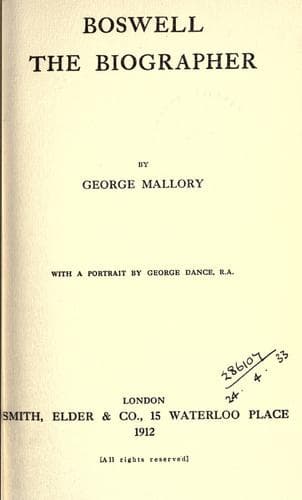
Authors, Scottish -- 18th century -- Biography; Biographers -- Great Britain -- Biography; Boswell, James, 1740-1795
Boswell was not unlike many people inasmuch as he found out rather
late in life the true value of his wife, and was more sorry than could
have been expected when he no longer had her help and companionship;
he found perhaps that he had rated too highly by comparison the
greater intellectual stimulus of his literary circle. His sorrow in
any case, at her death, whatever the proportion of remorse to the
sense of loss, is pleasant to see. There was so much affectation in
his character, that whenever he shows that he had simple, genuine
feelings--and he had them more often than might be supposed--we must
have some regard for them, however commonplace they may be.
Boswell was evidently quite miserable at his loss; he was unrestrained
in grief as he was in enjoyment, and the tale of his woe was poured
out to Temple in the same fervid manner as the love affairs of earlier
years:
I am amazed when I look back. Though I often and often dreaded
this loss, I had no conception how distressing it would be.
May God have mercy on me! I am quite restless and feeble and
desponding.... I have an avidity for death; I eagerly wish to
be laid by my dear wife; years of life seem insupportable.
I cannot express to you, Temple [he writes in a later letter],
'what I suffer from the loss of my valuable wife and the
mother of my children. While she lived, I had no occasion to
think concerning my family; every particular was thought of
by her, better than I could. I am the most helpless of human
beings; I am in a state very much that of one in despair.'
It must not be thought that Boswell faced the world in the sad and
sometimes complaining vein in which he wrote to Temple. There was no
whining self-pity, and no pride of the grievance, as might perhaps
have been expected, in his public attitude. 'It is astonishing what
force I have put upon myself since her death, how I have entertained
company, &c., &c.'[5] He no doubt tried to be cheerful in company, and
probably he succeeded.
The weakness of Boswell was shown in a different way, by an increase
of those vices which he had been encouraged to resist by Johnson, and
also, we may suppose, by his wife. Johnson had said, long before the
bereavement: 'In losing her you would lose your sheet-anchor, and be
tost, without stability, by the waves of life.' This prediction was
fulfilled.
Boswell had always been a self-indulgent man. Before his marriage he
was, as may be seen from the letters, sexually self-indulgent. Whether
he was so in later years, or in what degree, it is difficult to
determine; he may have been alluding to this when he talks of 'little
fondnesses,' and of being 'dissipated';[6] and the fact that he says
on one occasion that he had no 'confessions' to make rather suggests
the possibility that this may not always have been the case, though he
never actually confesses.
Public-domain text, read in full here on John Shaqi.
Reviews
Reviews
No reviews yet
Be the first to share your thoughts on this work.
Elsewhere in the archive
Join the Discussion
Join the discussion
Sign in to leave a comment or review.
Sign InorCreate an account