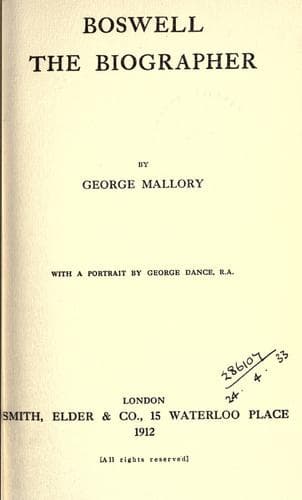
Authors, Scottish -- 18th century -- Biography; Biographers -- Great Britain -- Biography; Boswell, James, 1740-1795
Of Boswell's sorrows in later life, of his failure to realise those
'towering hopes,' and consequent disappointment, something has been
said already in these pages. It was not apparently until the autumn of
1789 that Boswell began to see that he was not destined to succeed in
the manner he wished--in politics and in the law. The letters at
this time were more frequent than usual, and we are able to see how,
earlier in the year, he was quite hopeful about the future, but later
became despondent.
A further reason depressed Boswell's spirits at this time: in the
summer of 1789 he lost his wife.[3] It is greatly to the credit of
Boswell that he was very deeply affected by her death--to his credit,
not because as a husband he was able to retain affection for his wife
(for affections are not completely under our control), but because
he was able to appreciate a woman who from his own accounts must have
been a sensible, kind woman, and one who treated him with a patient
consideration.
Boswell was not a good husband, because he never became in the
ordinary sense domesticated; his home was never to him the predominant
interest. During her last illness he seems to have realised that he
might have behaved better towards his wife, and to have felt a true
remorse:
No man ever had a higher esteem or a warmer love for a wife
than I have for her. You will recollect, my Temple, how our
marriage was the result of an attachment truly romantic; yet
how painful is it to me to recollect a thousand instances of
inconsistent conduct. I can justify my removing to the great
sphere of England, upon a principle of laudable ambition; but
the frequent scenes of what I must call dissolute conduct are
inexcusable; and often and often when she was very ill, in
London have I been indulging in festivity with Sir Joshua
Reynolds, Courtenay, Malone, &c., and have come home late, and
disturbed her repose. Nay, when I was last at Auchinleck,
on purpose to soothe and console her, I repeatedly went from
home; and both on those occasions, and when neighbours visited
me, drank a great deal too much wine.[4]
He was remorseful too after the death of his wife that he had not been
present to comfort her at the end. And there was good reason. She, as
he remarked, would not have treated him so. But Boswell must not be
blamed too severely for this serious omission. His wife was suffering
with a disease from which, though it was certain she would not
recover, there was no immediate prospect of release. Boswell seems to
have expected from the medical opinion that her life would linger on
longer than actually it did: and, if it was not for pressing duties
that he left his wife, it was not for pleasure, but for the kind of
activity incident to the career he had chosen.
Public-domain text, read in full here on John Shaqi.
Reviews
Reviews
No reviews yet
Be the first to share your thoughts on this work.
Elsewhere in the archive
Join the Discussion
Join the discussion
Sign in to leave a comment or review.
Sign InorCreate an account