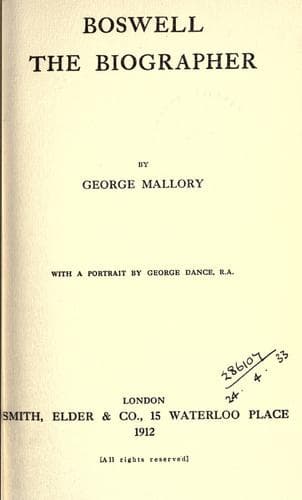
Authors, Scottish -- 18th century -- Biography; Biographers -- Great Britain -- Biography; Boswell, James, 1740-1795
His strong, clear, and animated enforcement of religion,
morality, loyalty, and subordination, while it delights
and improves the wise and the good, will, I trust, prove an
effectual antidote to that detestable sophistry which has
been lately imported from France, under the false name of
_Philosophy_, and with a malignant industry has been employed
against the peace, good order, and happiness of society, in
our free and prosperous country; but thanks be to God, without
producing the pernicious effects which were hoped for by its
propagators.
This history of the deeds and words and thoughts of his hero is
compared by Boswell to the Odyssey. He seems almost to think that the
merit of Homer's epic lies in the good behaviour of Ulysses, just as
he conceives that the value of his own work is in the excellence of
Johnson:--
----Quid virtus et quid sapientia possit,
Utile proposuit nobis exemplar Ulyssen.
It is not perhaps remarkable in itself that Boswell should have had
this attitude towards his work; it is the attitude in some degree
of most biographers, the attitude especially of the age in which he
lived, and the attitude of Johnson himself. Boswell's principles as a
biographer are indeed the same as Johnson's. We cannot suppose, when
he has revealed so clearly his supreme faculty for biography, that
there was anything of this which was not entirely his own. But he took
the trouble to find out on several occasions the opinions of his great
friend, to ask him about particular doubts which troubled him from
time to time, and obtain his approval. He had a profound respect for
Johnson's manner of estimating character. Mr. Pennant, 'a traveller
in Scotland,' is censured in the 'Life' for a book of travel which is
compared to Johnson's 'Journey to the Western Islands' and then quoted
on the subject of Johnson; the quotation speaks of 'the numerous
weaknesses and prejudices which his friends have kindly taken care to
draw from their dread abode.' Boswell's note is:
This is the common cant against faithful biography. Does the
worthy gentleman mean that I, who was taught discrimination of
character by Johnson, should have omitted his frailties, and
in short, have _bedaubed_ him, as the worthy gentleman has
bedaubed Scotland?
Public-domain text, read in full here on John Shaqi.
Reviews
Reviews
No reviews yet
Be the first to share your thoughts on this work.
Elsewhere in the archive
Join the Discussion
Join the discussion
Sign in to leave a comment or review.
Sign InorCreate an account