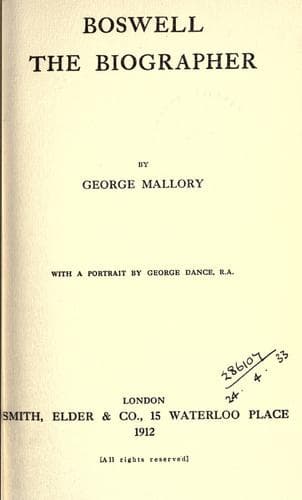
Authors, Scottish -- 18th century -- Biography; Biographers -- Great Britain -- Biography; Boswell, James, 1740-1795
And he will be seen as he really was; for I profess to write
not his panegyrick, which must be all praise, but his Life;
which, great and good as he was, must not be supposed to
be entirely perfect. To be as he was, is indeed subject of
panegyrick enough to any man in this state of being; but in
every picture there should be shade as well as light, and
when I delineate him without reserve, I do what he himself
recommended, both by his precept and his example.[8]
The 'Life' then is, as Boswell intended, a complete picture of
Johnson; complete, inasmuch as it gives a picture of Johnson in every
phase of his living, as the writer, the talker, the correspondent, and
most of all simply as a man in his dealings with other men, and in
all these gives a living picture: complete especially in this, that it
gives not merely what there is to praise in Johnson, but every little
detail as it occurred, the shade as well as the light.
But Boswell had something further in his mind as he wrote the 'Life.'
He was, as we have said before, essentially the moralist. He seems to
have had a purpose as he wrote, not only of not doing moral harm, but
of doing moral good. When he talks of the faults of Dr. Johnson he
does so with a kind of apology and explanation, with quotations from
the great moralist himself, to show that to mention the vices of a
famous man may as well do good as harm:
When I objected [evidently for the sake of argument] to the
danger of telling that Parnell drank to excess, he said, that
'it would produce an instructive caution to avoid drinking,
when it was seen that even the learning and genius of Parnell
could be debased by it.' And in the Hebrides he maintained, as
appears from my journal, that a man's intimate friend should
mention his faults, if he writes his life.
After saying that 'it must not be concealed, that like many other good
and pious men, among whom we may place the Apostle Paul upon his own
authority, Johnson was not free from propensities which were ever
"warring against the law of his mind," and that in his combat with
them, he was sometimes overcome,' he gives a moral lecture to his
readers:
But let no man encourage or soothe himself in 'presumptuous
sin,' from knowing that Johnson was sometimes hurried into
indulgences which he thought criminal. I have exhibited this
circumstance as a shade in so great a character, both from my
sacred love of truth, and to shew that he was not so weakly
scrupulous as he has been represented by those who imagine
that the sins, of which a deep sense was on his mind, were
merely such little venial trifles as pouring milk into his tea
on Good Friday.
In the 'Advertisement to the Second Edition,' Boswell seems to go
further:
Public-domain text, read in full here on John Shaqi.
Reviews
Reviews
No reviews yet
Be the first to share your thoughts on this work.
Elsewhere in the archive
Join the Discussion
Join the discussion
Sign in to leave a comment or review.
Sign InorCreate an account