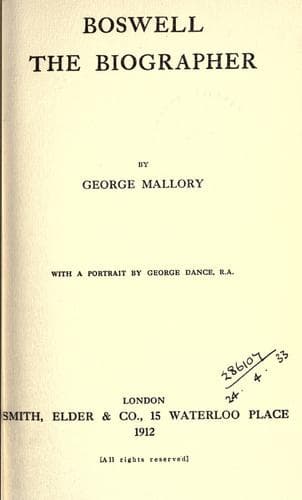
Authors, Scottish -- 18th century -- Biography; Biographers -- Great Britain -- Biography; Boswell, James, 1740-1795
This, like the other scene, is extremely dramatic. Neither would have
been so had not the writer himself realised the full humour of the
situation. Perhaps the most remarkable quality of the descriptions
is the amount left out.[4] The few details which Boswell gives us
are sufficient to reveal the secret of everybody's feelings, and then
Johnson strikes in with the characteristic remark. It is difficult
to appreciate to the full the merit of these scenes without comparing
them with those supplied by less talented pens; when we read the
accounts of Mrs. Piozzi and Sir John Hawkins, and even of Miss Burney,
we realise the immeasurable superiority of Boswell's. They have the
elusive quality of all impressionist[5] art; they might be ranked with
the nocturnes of Whistler: if they were produced, as it almost seems
they were, with as little apparent care, they were produced, however,
only by the experience of a lifetime. By continually thinking
'Johnson,' Boswell was able to give the few necessary touches which
expressed the inward vision.
In the two passages we have quoted, Boswell has revealed the humour of
a situation; those supreme moments of Johnson's dictatorship were
to him a never-failing treasure-house of priceless mirth; and he has
given us a key which enables us to hear with him the magic thunder, to
see each bright flash of the lightning, and with him to laugh the rich
mellow laughter because it is so absurd, and yet so inevitable, and so
good, that men should have been fashioned so.
Boswell delights in showing us the mind of Johnson, how he was
prompted like the rest of us by all the little motives of men. He
enjoys Johnson's humanity. Sometimes he is more solemn. One great
subject is Johnson's tenderness--as in an account of an argument with
Sir Joshua about drinking:
_Johnson_ (who from drinking only water supposed everybody who
drank wine to be elevated): 'I won't argue any more with
you, Sir. You are too far gone.' _Sir Joshua_: 'I should have
thought so indeed, Sir, had I made such a speech as you have
now done.' _Johnson_ (drawing himself in, and I really thought
blushing): 'Nay, don't be angry. I did not mean to offend
you.'
The best instance perhaps of Johnson's compunction after rudeness is
on the occasion of Dr. Percy's defence of Dr. Mounsey:
Public-domain text, read in full here on John Shaqi.
Reviews
Reviews
No reviews yet
Be the first to share your thoughts on this work.
Elsewhere in the archive
Join the Discussion
Join the discussion
Sign in to leave a comment or review.
Sign InorCreate an account