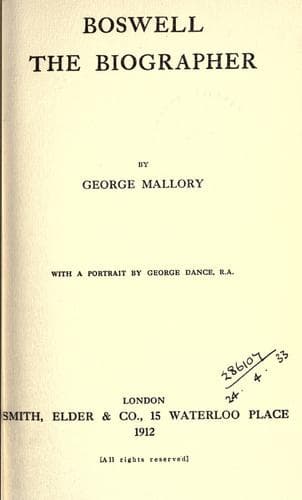
Authors, Scottish -- 18th century -- Biography; Biographers -- Great Britain -- Biography; Boswell, James, 1740-1795
His fervent attachment to Dr. Johnson at the early age of
three-and-twenty, when the dissipation and amusements of
London hold out to men of such lively parts as he possessed
irresistible attraction, reflects great credit on his memory.
His veneration and esteem for his friend induced him, at
a subsequent period, to go through the laborious task of
arranging and digesting the immense mass of materials with
which his own diligence and the kindness of his friends had
furnished him; and of forming his history of the life of that
excellent and extraordinary man; one of the most instructive
and entertaining books in the English language.... Mr. Boswell
undoubtedly possessed considerable intellectual powers, for
which he has not had sufficient credit; many supposing him to
be a mere relator of the sayings of others: but it is manifest
to every reader of any discernment that he never could have
collected such a mass of information and just observation on
human life as his very valuable work contains, without great
strength of mind and much various knowledge; as he never could
have displayed his collections in so lively a manner as he has
done, had he not possessed a very picturesque imagination, or,
in other words, had he not had a very happy turn for poetry as
well as for humour and for wit.
Mr. Malone ends his letter by paying a final tribute to the affection
of Boswell's friends:
He will long be regretted by a wide circle of friends, to whom
his good qualities and social talents always made his company
a valuable accession; and by none more sincerely than the
present vindicator of his fame.
* * * * *
Life is commonly somewhat of a battle. Blows are given and received.
Flags are lost and won. Positions are captured and surrendered. Limbs
are crushed and amputated. There are many ugly wounds; some bleed and
fester; some are healed. It is natural to look back on life, as the
general surveys the battlefield and the hospitals, to count the score.
At the end of all the struggle and the horror, the strange joys and
the fantastic dreams, what has happened? What view does the fighter
take himself? Was the cause worth struggling for, after all is done?
Would he fight on the same side if he could start again? Would he
refrain from fighting? Or would he fight with a different object? Is
the essential man the same? Or have his ambitions and desires and the
vital force of the man been modified? And if so how much? Can they be
recognised as the same equipment with which he set forth, or has the
consuming fire burnt out, and the bright flame grown pale and dim?
Public-domain text, read in full here on John Shaqi.
Reviews
Reviews
No reviews yet
Be the first to share your thoughts on this work.
Elsewhere in the archive
Join the Discussion
Join the discussion
Sign in to leave a comment or review.
Sign InorCreate an account