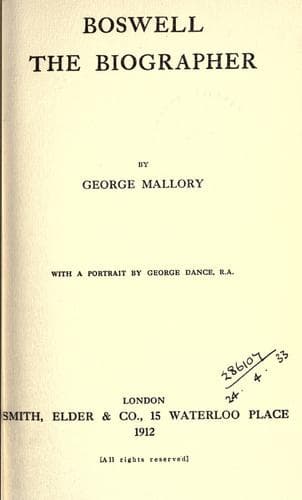
Authors, Scottish -- 18th century -- Biography; Biographers -- Great Britain -- Biography; Boswell, James, 1740-1795
Boswell was not an old man when he died; and apart from the
prostration caused by ill-health--for he was frequently ill towards
the close of his life--his robust vigour seems hardly to have
diminished. In July 1790, a year after Mrs. Boswell's death, he seems
already to entertain some matrimonial scheme.[10] This apparently
was the first of a fresh suite. In the spring of 1791 he is looking
forward to the pleasure of meeting a certain Miss Bagnal, 'who may
probably have six or seven hundred a year.' 'Here then I am,
my Temple,' exclaims Boswell, 'my flattering self! A scheme, an
adventure, seizes upon my fancy.' Assuredly this is the old Boswell.
In his whole outlook upon life Boswell, in fact, changed very little.
He had failed in the main battle; the ambitious dreams which pleased
him most had not come to pass. Neither as politician nor as barrister
had he won the smallest degree of fame. He was, and is, famous in a
rarer sort: yet he had esteemed literary fame at a much lower rate.
And at the end of his life he still measured distinction by the same
old standards. He felt that the struggle had gone against him: but
he never doubted of the cause for which he was fighting. As late as
August 1791, some months after the 'Life of Johnson' appeared, he
wrote to Temple as though he were on the eve of a legal career:
I have gone the full round of the Home Circuit, to which I
have returned, finding it much more pleasant, and, though I
did not get a single brief, do not repent of the expense, as
I am showing myself desirous of business and imbibing legal
knowledge.
He still was building castles in the air of the old type; still,
sometimes, he took an opportunity to be 'conspicuous' and made
conscious efforts to 'be the great man.' Almost simultaneously with
the 'Life,' he published a political poem, 'No Abolition of Slavery,
or The Universal Empire of Love.' It was of a semi-frivolous nature,
the argument being drawn from a premise that slavery is the most
agreeable of 'goods,' when it is enforced by the chains of loving
devotion. The name of Miss Bagnal is introduced, and it is difficult
to tell whether the whole may not be an elaborate attempt to bring off
a marriage with that lady. But it is evident from a remark to Temple,
that the main purpose is political:
I am thinking to curtail my poem on the Slave Trade, and throw
it into the world just before the great question comes on next
Wednesday.
A rumour of war with Russia also rouses the public spirit of Boswell
to seek distinction, and he hesitates
whether I should not write one of my characteristical
pamphlets on this crisis--An Appeal to the People upon the
threatened project of involving this country in a war with
Russia, in order to assist the Turks.
Public-domain text, read in full here on John Shaqi.
Reviews
Reviews
No reviews yet
Be the first to share your thoughts on this work.
Elsewhere in the archive
Join the Discussion
Join the discussion
Sign in to leave a comment or review.
Sign InorCreate an account