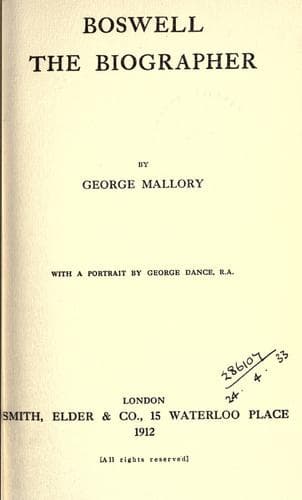
Authors, Scottish -- 18th century -- Biography; Biographers -- Great Britain -- Biography; Boswell, James, 1740-1795
When Boswell had left Auchinleck and came to live in London, his
opportunities for interesting himself in the welfare of his tenants
and dependants were naturally curtailed. With the strict view of a
landlord's obligations which is commonly held in this age, we may be
inclined to condemn Boswell simply on the ground that he did not live
upon his estate. But, though Ayrshire is a far cry from London, the
Laird of Auchinleck did not forget his position. He was willing to
travel to Scotland 'to transact business with my tenants.' On one
occasion, in 1793, he undertook the journey in order to see that the
parish was provided with a suitable parson: 'The choice of a minister
to a worthy parish is a matter of importance, and I cannot be sure
of the real wishes of the people without being present.' He went to
Auchinleck not because he enjoyed going, but because he thought
he ought to go: 'though the journey will no doubt be uncomfortable
(probably because Boswell was in bad health), and my being alone in
that house where once I was so happy, be dreary in a woeful degree,
the consciousness of duty, and being busy, will I hope support me.'
In Boswell's will special provisions were made for his tenants and
servants:
As there are upon the estate of Auchinleck several
tenants whose families have possessed their farms for many
generations, I do by these presents grant leases for nineteen
years and their respective lifetimes of their present farms
to John Templeton etc.... And I do beseech all the succeeding
heirs of entail to be kind to the Tenants and not turn out old
possessors to get a little more rent.
'Seldom,' exclaims Dr. Rogers, 'has Scottish landlord evinced greater
consideration for his tenantry and domestics.'
As a father, Boswell was no less kind. He had had six children
altogether, three sons and three daughters;[12] one of the sons had
died early in 1777. His interest in his children no doubt increased
very much after their mother's death. Frequently in the 'Letters
to Temple' after that event (June, 1789) one or other of them is
mentioned, and Boswell shows anxiety both for their present happiness
and for their future welfare. Malone, in answering a detractor of
Boswell's, says:
This writer acknowledges that he was an affectionate father;
he was more; he was extremely liberal and indulgent to his
children, having, for some years past, expended out of his
moderate income, £300 a year to educate his two sons, one at
Eton and the other at Westminster, and one of his daughters
at a boarding-school: to effect which he confined his own
personal expenses within the narrowest bounds.
That Boswell could stint himself in this way for his children shows a
larger degree of self-sacrifice than might be expected from one of his
extravagant tastes. It shows also a development in his character. The
old passion for being conspicuous could now be put aside for the sake
of his children.
Public-domain text, read in full here on John Shaqi.
Reviews
Reviews
No reviews yet
Be the first to share your thoughts on this work.
Elsewhere in the archive
Join the Discussion
Join the discussion
Sign in to leave a comment or review.
Sign InorCreate an account