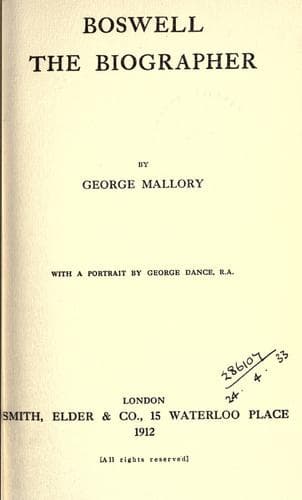
Authors, Scottish -- 18th century -- Biography; Biographers -- Great Britain -- Biography; Boswell, James, 1740-1795
Boswell, in fact, became less extravagant and affected towards the end
of life. He was less often carried away by his 'warm imagination.' He
lived less in his 'castles in the air,' and nearer the solid earth.
* * * * *
The next cause of this development is not far to seek. It lies in the
result of the main struggle in Boswell's life. Truth had won the day.
The irrepressible quality of Boswell's genius had triumphed in spite
of his commonplace aims and the conventionality of his beliefs and
standards; and it had found its expression in biography. The nature
of that triumph reacted inevitably upon Boswell. The highest of his
qualifications for writing the 'Life of Johnson' was simply honesty.
He was honest about human nature. He had related without omission and
without perversion the story of a man as he had witnessed it. All his
powers of observing and of judging character had been brought to bear
upon the great work of his life. His own character had developed in
the process. It is impossible for a man to concentrate all his mind
upon the effort to understand the human being, without involving
himself in his investigations; and Boswell was no exception. He
had always been interested in his own character, though in a rather
uncritical fashion; and no doubt, as often happens, his knowledge
of others began with himself. He was himself both the primer of
psychology and the standard for comparison, upon which his whole view
of individuals was based; and it is often clear, when he is discussing
some moral question, that he has his own case in mind. The 'Life of
Johnson' was necessarily concerned with Boswell in some degree; and
so it was that the author, when he came to record his observations
of Johnson and his friends and acquaintances, found that the process
which he applied to others was being applied to himself.
Nothing in Boswell's 'Life of Johnson' is more remarkable, as nothing
is more charming, than the author's candour when his own person is
concerned. He does not obtrude himself upon the reader's notice;
he relates the events quite naturally as they occurred. And though
Boswell was not a little vain, he was able to relate what was not
to his credit. Most of the stories of Boswell's folly we know from
himself. He has recorded the sledge-hammer blows of Johnson provoked
by his own absurdity; he has told us of occasions when he lacked
in manners, even when, more than once, he was drunk in a lady's
drawing-room; he has described at length, in the 'Tour to the
Hebrides,' the story of a carouse at Corrichatachin, and has not
failed to mention how very ill he felt next morning, and how much he
dreaded Johnson's rebuke; it is in his own account that we read of
the ridiculous figure he cut in a storm at sea; it is from his own
correspondence with Johnson that we learn of all the weaknesses that
earned the Doctor's reproof.
Public-domain text, read in full here on John Shaqi.
Reviews
Reviews
No reviews yet
Be the first to share your thoughts on this work.
Elsewhere in the archive
Join the Discussion
Join the discussion
Sign in to leave a comment or review.
Sign InorCreate an account