4. COLEOPTERA.
Zonitis mutica, FAB. (parasite of Osmia tridentata).
Most of these insects have been submitted to a learned expert, Professor
Jean Perez, of Bordeaux. I take this opportunity of renewing my thanks
for his kindness in identifying them for me.--Author's Note.)
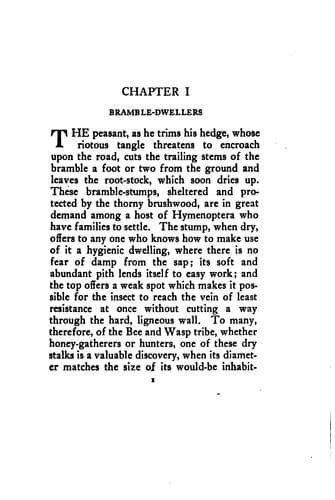
They include members of very diverse corporations. Some, more
industrious and equipped with better tools, remove the pith from the dry
stem and thus obtain a vertical cylindrical gallery, the length of which
may be nearly a cubit. This sheath is next divided, by partitions, into
more or less numerous storeys, each of which forms the cell of a larva.
Others, less well-endowed with strength and implements, avail themselves
of the old galleries of other insects, galleries that have been
abandoned after serving as a home for their builder's family. Their only
work is to make some slight repairs in the ruined tenement, to clear the
channel of its lumber, such as the remains of cocoons and the litter of
shattered ceilings, and lastly to build new partitions, either with
a plaster made of clay or with a concrete formed of pith-scrapings
cemented with a drop of saliva.
You can tell these borrowed dwellings by the unequal size of the
storeys. When the worker has herself bored the channel, she economizes
her space: she knows how costly it is. The cells, in that case, are all
alike, the proper size for the tenant, neither too large nor too small.
In this box, which has cost weeks of labour, the insect has to house the
largest possible number of larvae, while allotting the necessary amount
of room to each. Method in the superposition of the floors and economy
of space are here the absolute rule.
But there is evidence of waste when the insect makes use of a bramble
hollowed by another. This is the case with Tripoxylon figulus. To obtain
the store-rooms wherein to deposit her scanty stock of Spiders, she
divides her borrowed cylinder into very unequal cells, by means of
slender clay partitions. Some are a centimetre (.39 inch.--Translator's
Note.) deep, the proper size for the insect; others are as much as two
inches. These spacious rooms, out of all proportion to the occupier,
reveal the reckless extravagance of a casual proprietress whose
title-deeds have cost her nothing.
But, whether they be the original builders or labourers touching up the
work of others, they all alike have their parasites, who constitute
the third class of bramble-dwellers. These have neither galleries to
excavate nor victuals to provide; they lay their egg in a strange cell;
and their grub feeds either on the provisions of the lawful owner's
larva or on that larva itself.
Public-domain text, read in full here on John Shaqi.
Reviews
Reviews
No reviews yet
Be the first to share your thoughts on this work.
Join the Discussion
Join the discussion
Sign in to leave a comment or review.
Sign InorCreate an account