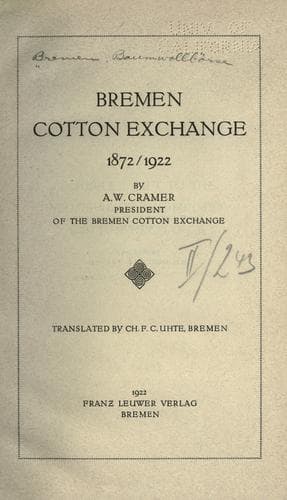
Bremen Cotton Exchange, 1872/1922Cramer, Andreas Wilhelm
History
Bremen Cotton Exchange, 1872/1922
Cramer, Andreas Wilhelm
Bremen (Germany). Baumwollbörse; Cotton trade
A spinner sells his yarns for a distant delivery, at that moment,
however, it does not suit him to buy the cotton, he prefers to cover
himself in futures, and therefore buys 200 bales December "futures" in
New-York at 20 cents. He has calculated that the sale price of his
yarns allows him to pay 24 cents for goodmiddling. He watches the
market for a favorable opportunity to buy "goodmiddling", he succeeds
in buying 200 bales at 300 "on" December. On arrival of the 200 bales,
he fixes the price with his seller, now he must be careful to liquidate
his "future" contract at the same moment. Both are done at 18 cents,
and he loses 2 cents on his "futures". The cotton, however, costs him
18 cents, plus the 300 points "on", equal to 21 cents, he therefore
makes a profit of 3 cents on the calculated purchase price of 24 cents,
from this are to be deducted, the 2 cents loss on the "futures",
remaining, one cent net profit. The fluctuations of the market had
nothing to do with this profit, which he had, so to say, in his pocket
right from the commencement, as he had sold his yarns on the basis of
24 cents for cotton, with "futures" at 20 cents, in fact, he bought his
cotton at 300 "on" for goodmiddling, with the value of "futures" at 20
cents, which equals 23 cents. The hedge business, therefore, does away
with the market risk, now in what consists its value? The profit on
cotton does not lie in the fluctuations of the market, one has to look
for it elsewhere. The chances of profit-making are to be found for the
merchant in judicious buying, while, for the manufacturer, they consist
in the lucrative production of his finished articles.
The merchant requires for advantageous buying, far reaching connections
and a wide spread organisation, he has to survey the entire field of
cotton production, he must watch for every opportunity where cotton is
pressed for sale, he must know which district has grown the qualities
mostly preferred, in short, he has to keep himself extremely well
posted. The consumer has to work with the same tension, to find the
devious ways which lead to a profitable result in his business. Hardly
ever do big profits stare one in the face, and should a particular good
opportunity arise, it never lasts long, as everybody wishes to
participate in it, which, of course, spoils the best chance. For the
common welfare, competition tends to reduce the prices of everything to
the lowest possible level, that is the natural course of events.
Occasional deviations are simply exceptions, that, according to the old
proverb: "prove the rule".
What is the technical value of a market?
Public-domain text, read in full here on John Shaqi.
Reviews
Reviews
No reviews yet
Be the first to share your thoughts on this work.
Join the Discussion
Join the discussion
Sign in to leave a comment or review.
Sign InorCreate an account