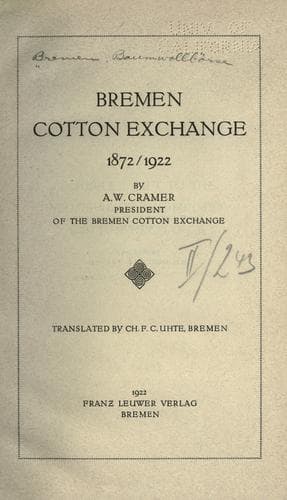
Bremen Cotton Exchange, 1872/1922Cramer, Andreas Wilhelm
History
Bremen Cotton Exchange, 1872/1922
Cramer, Andreas Wilhelm
Bremen (Germany). Baumwollbörse; Cotton trade
A.: Nobody can look into the future. At the present minute, we
witness the biggest economic collapse that the world has ever seen,
all countries suffer from it, except Germany. All states had made
preparations for peace, now the stored up goods are lying there and
nobody wants them, not even Germany. We thought, that Germany, bare
of everything, would swallow anything.
G.: The reason is, that Germany cannot pay. Her gold and tangible
gold values have been taken from her. Why do not the other
countries buy? Their peace production has been lying idle for
years, consequently, the shelves must be fairly empty.
A.: Quite right, but prices have risen to an unreasonable height.
During the war, a most wasteful regime prevailed; everybody made
big profits or received huge wages, and accustomed himself to a
most sumptuous life. Now, vengeance is upon them, for nature does
not allow herself to be ravished, nor does she present gifts for
extravagant living.
G.: If prices have been driven to an unreasonable level by wasteful
workings, then, a big decline in prices is the only remedy.
A.: We are in the midst of a phenomenal collapse of prices. Cotton
is a barometer for all other goods. The price in America is,
to-day, 11 cents, a short while ago, it was 40 cents.
G.: What does the planter say to this?
A.: The cost of production is for him this season about 25-30 cents
per pound. He has worked for nothing, and besides, loses a good
deal of money, as his means are small, he will be heavily in debt.
G.: And the further consequences?
A.: The planter is absolutely unable to produce a similar crop. It
is the old story, when prices are too low the crop will be
curtailed.
G.: We have always experienced that low prices are followed by high
ones. What other consequences is this collapse in prices likely to
have?
A.: All cotton goods fall in the same proportion as the raw
material, this means a bad crisis for commerce and industry, and an
unprecedented amount of unemployment. Besides, this collossal drop
in prices has caused other very peculiar situations.
G.: Of what nature?
A.: It is well known that cotton is rarely bought at a fixed price,
but generally, at the "future" price of the day on which the buyer
"calls" his cotton, plus or minus the agreed upon difference for
the quality bought. Now, several American houses sold low qualities,
at 12.50 cents "off". At that time, "futures" were 40 cents, so
that the seller calculated to receive about 27.50 cents, to-day,
"futures" are 11 cents, so that, if the buyer "calls" his cotton
to-day, he receives it for nothing, and can claim 1.50 cents per
pound as well.
Public-domain text, read in full here on John Shaqi.
Reviews
Reviews
No reviews yet
Be the first to share your thoughts on this work.
Join the Discussion
Join the discussion
Sign in to leave a comment or review.
Sign InorCreate an account