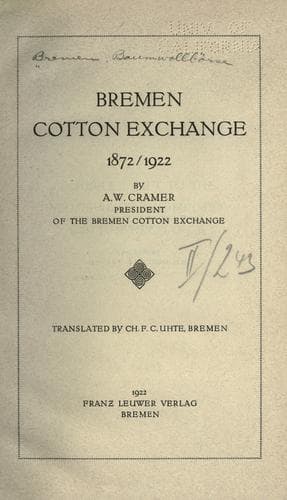
Bremen Cotton Exchange, 1872/1922Cramer, Andreas Wilhelm
History
Bremen Cotton Exchange, 1872/1922
Cramer, Andreas Wilhelm
Bremen (Germany). Baumwollbörse; Cotton trade
In the year 1902, the Bremen Cotton Exchange opened the doors to its
various tenants, and, as the outward appearance of a man has an
influence on the impression he makes upon us, so does the building
which houses the cotton trade, play its part. Previous to that date,
the business of the Exchange was carried on in rented rooms, but with
expanding trade, these became inadequate, and a new building was
contemplated; the idea was, to make the outward appearance worthy of
the importance of Bremen's cotton trade, with due consideration to the
local conditions. Bremen can boast of a thousand years history, and has
many fine examples of ancient architecture, notably around the market
place. There you find in the rich ornate style of the renaissance, the
"Rathaus" (town hall) and in another style, that however blends
harmoniously, is the "Schütting" (the seat of the chamber of commerce),
the "Dom" (cathedral), the "General Exchange", as well as a number of
private houses of a later date. The combined appearance of these
various buildings, form an imposing picture. The site for the new
exchange is situated in this very neighbourhood, consequently, a
building had to be designed that fitted in with the whole scheme.
Prominent architects competed, and the plans that gained the first
price were accepted, and commissioned for execution. Unfortunately, it
was proved later on, that the choice had not been a lucky one. The
architect adopted the style of the ancient "Rathaus", but the rich
ornamentations of this architecture, proved its doom. Beautiful as the
effect was on the smaller, gracefully built, Rathaus, yet on the
ponderous building of the "Exchange", it was utterly unsuitable, and
another thing the architect did not consider sufficiently: The old
guild masters, with their circumspection and devotion, erected
buildings to last an eternity, while now-a-days, all is hurry and
scurry, the sooner the job is finished the better, as fresh orders are
waiting. This may, possibly, be some excuse for the little care
bestowed upon the selection of the material. The soft sandstone
selected, was excellently suited to the quick sculpturing of the
over-rich ornaments, nevertheless, it was a ghastly mistake to have
chosen it. Ten years after the building was finished one of the
decorations, loosened by the weather, fell, and killed a member of the
Exchange. An examination showed that a great number of projecting
stones were so weatherworn, that they crumbled in the hand. An ugly
scaffolding had to be erected to protect the street traffic. Measures
were at once taken to construct the front of the building more solidly;
the most prominent experts were asked for their advice, but the war
broke out, and nothing could be done. During the first years after the
war, want of money prevented the starting of the repairs. These had
become more extensive, owing to the revolution, when the building had
been under artillery and rifle fire. At last, however, came the
Public-domain text, read in full here on John Shaqi.
Reviews
Reviews
No reviews yet
Be the first to share your thoughts on this work.
Join the Discussion
Join the discussion
Sign in to leave a comment or review.
Sign InorCreate an account