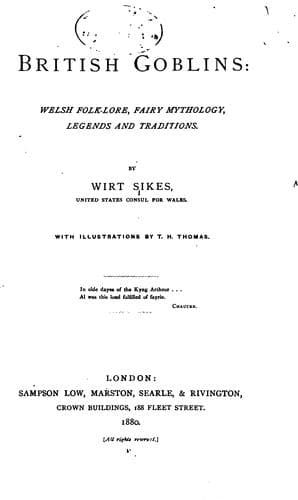
British Goblins: Welsh Folk-lore, Fairy Mythology, Legends and TraditionsSikes, Wirt
History
British Goblins: Welsh Folk-lore, Fairy Mythology, Legends and Traditions
Sikes, Wirt
Folklore -- Wales; Goblins -- Wales; Mythology, Celtic -- Wales; Mythology, Welsh; Wales -- Social life and customs
This same Rev. Thomas Lewis was well acquainted with a man who was
similarly employed by a perturbed spirit, and was at the man's bedside
when he died. This ghost was in appearance a clergyman, dressed in
black clothes, with a white wig on. As the man was looking out of an
ale-house window one night, he saw this ghost on horseback, and went
out to him. The ghost bowed and silently offered him drink; but this
was declined. Thereupon the ghost lifted his hat, crooked his elbow,
and said in a hollow tone, 'Attoch chwi, syr,' (towards you, sir).
But others who were there could see nothing and hear nothing. The
ghost then said, 'Go to Clifford Castle, in Radnorshire, take out some
money which lies hidden there, and throw it into the river. Do this, I
charge thee, or thou shalt have no rest.' Further and more explicit
directions were then given, and the unhappy man set out, against his
will, for Clifford Castle, which is the castle in which was born Fair
Rosamond, King Henry II.'s beautiful favourite. No one but himself was
allowed to enter the castle, although he was permitted to have a
friend's company to the ruined gate thereof. It was dark when they
came to the castle, but he was guided to the place where the money
was, and ran with it and flung it into the river. After that he was
haunted no more.
An old house at Ty'n-y-Twr, in Carnarvonshire, was haunted by a ghost
whose troubles were a reversal of the rule. A new tenant, who took
possession of the house a few years ago, was so bothered by this
spectre that he resolved to question it. He did so and got for answer
the information that if he would deposit a particular sum of money in
a specified place, his ghostship would cease to walk. The man actually
did this, and it acted like magic. The money disappeared with
promptitude, and the ghost came there no more.
A man at Crumlyn, Monmouthshire, was haunted by a ghost whose trouble
related to a hidden object of small value. Nevertheless the spectre
was so importunate that the man set out one night to accompany it to
the scene of perturbation. In due time they came to a huge stone,
which the ghost bade its friend lift up, who replied that he had not
sufficient strength, it being a pretty large rock he was thus
requested to move. 'But try,' said the ghost. So he tried, and lo! it
was lifted as if it had been a feather. He drew forth a pike, or
mattock; 'and the light,' the man afterwards related, 'was as great as
if the sun shone; and in the snow there was no impression of the feet
of either of us.' They went to the river, and by the ghost's command
the man threw the pike over his head into the water, standing with his
back to the flood. The ghost then conducted him home, and never
troubled him more. But for a long time after he was out of his senses.
This was an illustration, according to the popular belief, of the
wickedness of hiding anything, however trifling its value--a practice
strongly condemned by the Welsh peasantry.
Public-domain text, read in full here on John Shaqi.
Reviews
Reviews
No reviews yet
Be the first to share your thoughts on this work.
Elsewhere in the archive
Join the Discussion
Join the discussion
Sign in to leave a comment or review.
Sign InorCreate an account