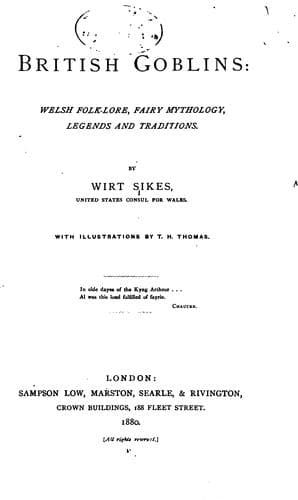
British Goblins: Welsh Folk-lore, Fairy Mythology, Legends and TraditionsSikes, Wirt
History
British Goblins: Welsh Folk-lore, Fairy Mythology, Legends and Traditions
Sikes, Wirt
Folklore -- Wales; Goblins -- Wales; Mythology, Celtic -- Wales; Mythology, Welsh; Wales -- Social life and customs
There is a Glamorganshire story about a certain young man who,
returning late at night from courting his sweetheart, felt tired, and
sitting down fell asleep. He had not slept long when he was aroused by
a strange noise, and looking up recognised the ghost of his departed
grandfather. Enquiring the cause of the old gentleman's visit to this
scene of trials, he got this answer: 'Under the corner of the thatch
of your roof, look and you will find a pair of silver spurs,
surreptitiously obtained by me when in the flesh, and hidden there.
Throw them into the river Taff, and I shall be at peace.' The young
man obeyed these instructions, and found the spurs accordingly; and
although many persons were present when he climbed to the roof and
fumbled under the thatch, and saw him in the very act, not one among
them could see the spurs, which were to them invisible. They said,
however, that when the purloined spurs had been thrown into the river,
a bright flame was seen to flash along the water.
V.
A large proportion of these stories of ghostly perturbation concerning
hidden treasure include a further feature of great interest, relating
to transportation through the air. I have mentioned that ghosts
sometimes employ the services of the fairy Boobach in thus carrying
mortals from place to place. The fairies of Wales are indeed
frequently found to be on the best of terms with the ghosts. Their
races have much in common, and so many of their practices are alike
that one is not always absolutely sure whether he is dealing with a
fairy or a spectre, until some test-point crops up. However, in
transporting a mortal through the air, ghost and fairy work together.
The Boobach being set his task, complaisantly gives the mortal the
choice of being transported above wind, amid wind, or below wind. The
value of knowing beforehand what to expect, was never better
illustrated than in this place. The mortal who, with a natural
reluctance to get into an unpleasantly swift current, avoids
travelling mid-wind, misses a pleasant journey, for mid-wind is the
only agreeable mode of being borne by a Boobach. Should you choose to
go above wind, you are transported so high that you skim the clouds
and are in danger of being frightened to death. But choosing the
below-wind course is even worse, for then you are dragged through
bush, through briar, in a way to impress upon you the advice of Apollo
to Phaeton, and teach you the value of the golden mean. _In medio
tutissimus ibis._
VI.
Public-domain text, read in full here on John Shaqi.
Reviews
Reviews
No reviews yet
Be the first to share your thoughts on this work.
Elsewhere in the archive
Join the Discussion
Join the discussion
Sign in to leave a comment or review.
Sign InorCreate an account